TB-500 has become a familiar name in the research-peptide world, particularly in discussions involving tendon injuries, muscle recovery, wound healing, inflammation, and tissue repair.
There is legitimate science behind some of those conversations—but there is also an important catch:
A large portion of the research commonly attributed to TB-500 was actually conducted on thymosin beta-4 (Tβ4), a related but different molecule.
That distinction matters when evaluating what has actually been demonstrated and what is being extrapolated from research on another compound.
What Is Thymosin Beta-4?
Thymosin beta-4 is a naturally occurring peptide consisting of 43 amino acids. It is widely distributed throughout mammalian tissues and cells and has been investigated for its involvement in cellular migration, inflammation, angiogenesis, wound healing, and tissue regeneration.
Researchers became particularly interested in Tβ4 because several of those processes play important roles following tissue injury.
Experimental research has found that Tβ4 can promote cell migration and new blood-vessel formation—two processes that are important during wound repair.
So What Is TB-500?
This is where things get confusing.
TB-500 is associated with a fragment of thymosin beta-4 rather than simply being another name for the complete naturally occurring molecule.
The terms TB-500 and thymosin beta-4 are nevertheless frequently used interchangeably in online discussions and marketing.
They shouldn’t be.
A 2026 review specifically examining the literature surrounding Tβ4 and TB-500 found that the evidence base is heavily concentrated on full-length thymosin beta-4, while direct evidence involving TB-500 itself remains much more limited.
The FDA has made the distinction even clearer. In its scientific review of TB-500, the agency reported that its literature search found no studies in which TB-500 had been administered to humans.
That means human research involving thymosin beta-4 cannot simply be presented as human evidence for TB-500.
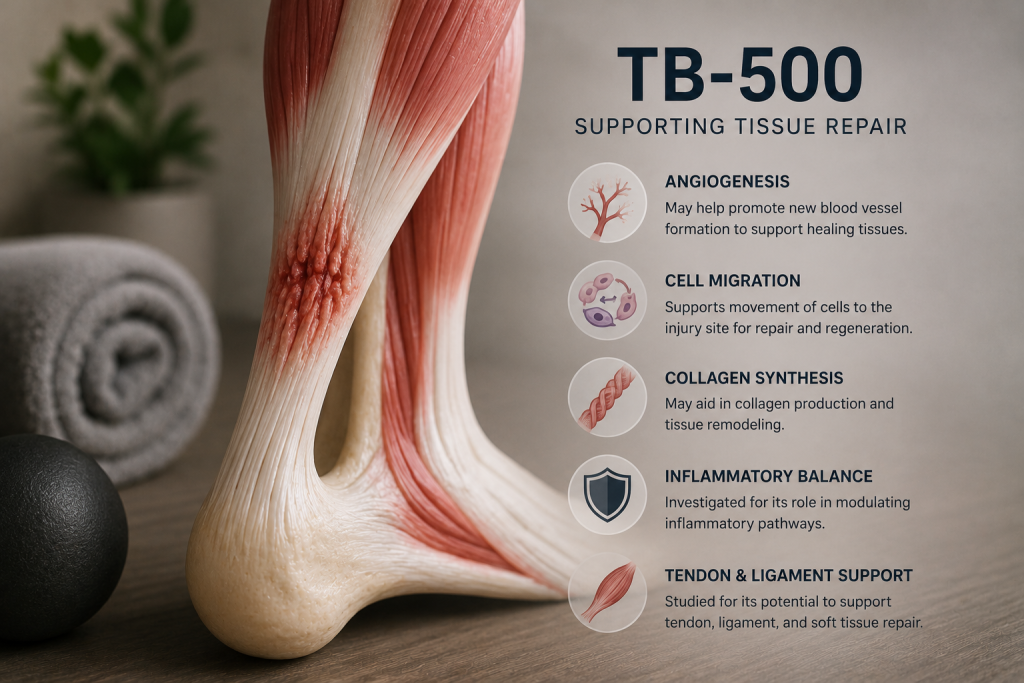
Why Are These Compounds Studied for Tissue Repair?
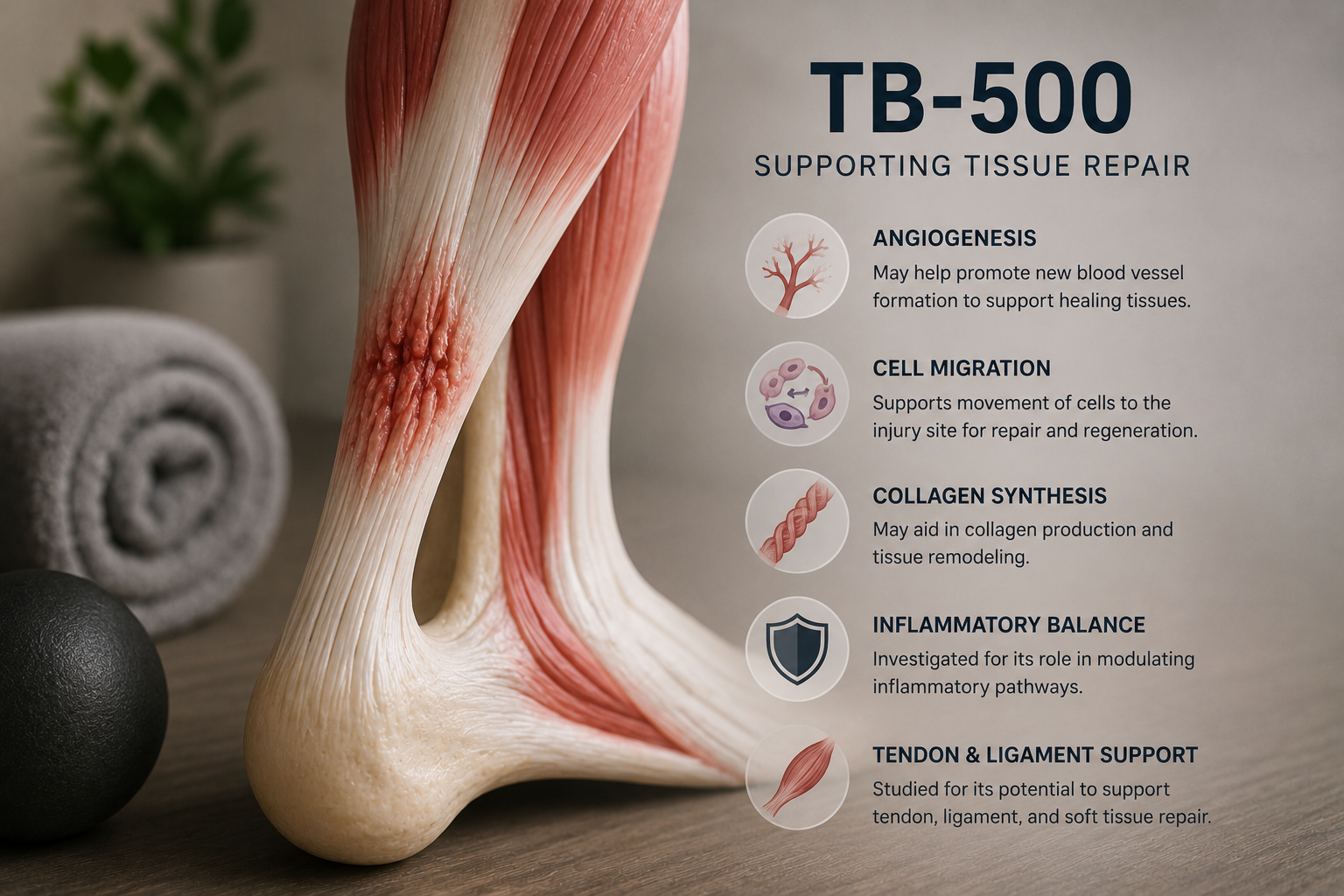
Much of the interest surrounding thymosin beta-4 comes from its involvement in several biological processes necessary for repairing damaged tissue.
Researchers have investigated effects involving:
- Cell migration
- Angiogenesis
- Collagen deposition
- Inflammatory signaling
- Tissue remodeling
- Wound closure
- Cellular protection and survival
Angiogenesis is particularly interesting.
When tissue is injured, restoring an adequate blood supply is an important part of the repair process. New blood vessels help deliver oxygen and nutrients to regenerating tissue.
Laboratory and animal research has shown that thymosin beta-4 can promote angiogenesis and cellular migration, providing a plausible mechanism for some of the wound-healing effects researchers have observed.
What Does the Wound-Healing Research Show?
Some of the strongest evidence surrounding thymosin beta-4 involves wound healing.
An early animal study found increased re-epithelialization, wound contraction, collagen deposition, and angiogenesis following Tβ4 treatment.
Those findings eventually contributed to human clinical research involving certain types of chronic wounds.
Unlike TB-500, full-length thymosin beta-4 actually has been studied in humans.
One double-blind, placebo-controlled Phase 2 study involving 73 patients examined topical Tβ4 in venous stasis ulcers. Researchers reported an acceptable safety profile in the study and found preliminary evidence suggesting that one concentration might accelerate healing.
Again, however, that was thymosin beta-4—not TB-500.
What About Tendons and Ligaments?
This is probably where TB-500 receives the most attention outside of laboratories.
Tendons are difficult tissues to repair because of their structure and relatively limited vascular supply. Researchers are therefore interested in compounds capable of influencing cellular migration, collagen organization, angiogenesis, and other components of tissue remodeling.
And we now have a particularly interesting piece of direct TB-500 research.
A 2026 animal study investigated BPC-157, TB-500, and their combination following surgically created Achilles tendon injuries in rats.
Researchers evaluated the repaired tendons using biomechanical testing as well as histological analysis, including examination of collagen types I and III.
The study provides direct experimental evidence involving TB-500 in tendon healing—but it involved only 32 rats, divided into four groups.
It therefore provides a useful research signal, not proof that TB-500 repairs human tendon injuries.
TB-500 and BPC-157
BPC-157 and TB-500 are frequently discussed together because both have become associated with tissue-repair research.
However, they are entirely different compounds.
BPC-157 is a synthetic 15-amino-acid peptide investigated predominantly through preclinical research.
TB-500 is associated with thymosin beta-4 biology.
The 2026 Achilles tendon study is noteworthy because researchers directly compared BPC-157, TB-500, and the combination in the same experimental model.
But this does not establish that combining the compounds is safe or effective in people.
It’s another example of why distinguishing between experimental findings and clinical evidence is essential when reading peptide research.
What About Inflammation?
Thymosin beta-4 has also been investigated for anti-inflammatory activity.
Inflammation is a normal and necessary component of healing, but prolonged or excessive inflammatory signaling can interfere with tissue repair.
Research reviews describe Tβ4 as having anti-inflammatory, anti-apoptotic, angiogenic, and anti-fibrotic activities that could contribute to its effects in experimental wound-healing models.
That makes inflammatory signaling an important part of the thymosin beta-4 research story.
But once again, evidence concerning Tβ4 cannot automatically be transferred to TB-500.
Does TB-500 Have Human Clinical Evidence?
This is perhaps the most important question in the entire article.
At present, direct human evidence for TB-500 is extremely limited.
In its review of the compound, the FDA reported that it found no published studies involving administration of TB-500 to humans.
Meanwhile, full-length thymosin beta-4 has a considerably larger research history, including human studies examining topical formulations for wound healing.
That difference creates one of the biggest problems when researching TB-500 online.
Someone may cite legitimate human research involving Tβ4 and then use that research to support a statement about TB-500.
The citation may be real.
The study may be real.
But the compound being discussed isn’t necessarily the compound that was actually studied.
Is TB-500 FDA Approved?
No.
TB-500 is not an FDA-approved medication.
That means the FDA has not approved TB-500 as safe and effective for treating tendon injuries, muscle injuries, inflammation, wound healing, athletic recovery, or other conditions for which it is commonly promoted online.
The FDA has also reviewed TB-500 in the context of pharmaceutical compounding and noted the lack of human administration data.
This doesn’t erase the experimental research.
It simply tells us where the evidence currently stands.
Why Does TB-500 Sound More Established Online Than It Actually Is?
Because three different things frequently get blended together:
Thymosin beta-4 biology, animal research, and TB-500 marketing.
There is a substantial scientific literature surrounding thymosin beta-4.
There is experimental evidence suggesting that Tβ4 can influence biological processes involved in tissue repair.
There is also emerging animal research directly involving TB-500.
But those facts don’t mean researchers have demonstrated that commercially marketed TB-500 safely heals injuries in humans.
A 2026 review of approved and unapproved peptide therapies specifically described a growing gray market surrounding compounds such as TB-500 and noted the differences between rigorously evaluated approved peptide drugs and unapproved peptides marketed for recovery and performance.
So, Is TB-500 Promising?
From a research standpoint, there are reasons to continue studying it.
Thymosin beta-4 biology provides a scientifically interesting foundation, and newer research is beginning to investigate TB-500 itself in tissue-healing models.
But the evidence needs to be described accurately.
We know considerably more about thymosin beta-4 than we know about TB-500.
We have evidence that Tβ4 participates in biological pathways involving angiogenesis, cell migration, inflammation, and tissue repair.
We have human clinical research involving certain Tβ4 formulations.
We have much less direct evidence involving TB-500—and the FDA’s review found no published studies administering TB-500 to humans.
So when you encounter claims that “TB-500 has been clinically proven” to heal tendons, repair muscle, accelerate recovery, or regenerate tissue, it’s worth asking one simple question:
Was the study actually conducted on TB-500?
Sometimes, the answer is no.
And understanding that difference is exactly what good peptide research should be about.
Research & Educational Disclaimer
This article is intended for general educational and research purposes only. It does not constitute medical advice or a recommendation to purchase, administer, dose, or use TB-500, thymosin beta-4, or any other research compound. TB-500 is not FDA approved for treating injuries or other medical conditions. Findings from laboratory and animal research do not establish safety or effectiveness in humans. Medical questions and treatment decisions should be discussed with an appropriately licensed healthcare professional.
Research Sources
2026 review of TB-500 and thymosin beta-4 research
2026 TB-500 and BPC-157 Achilles tendon animal study — PubMed
FDA scientific review of TB-500