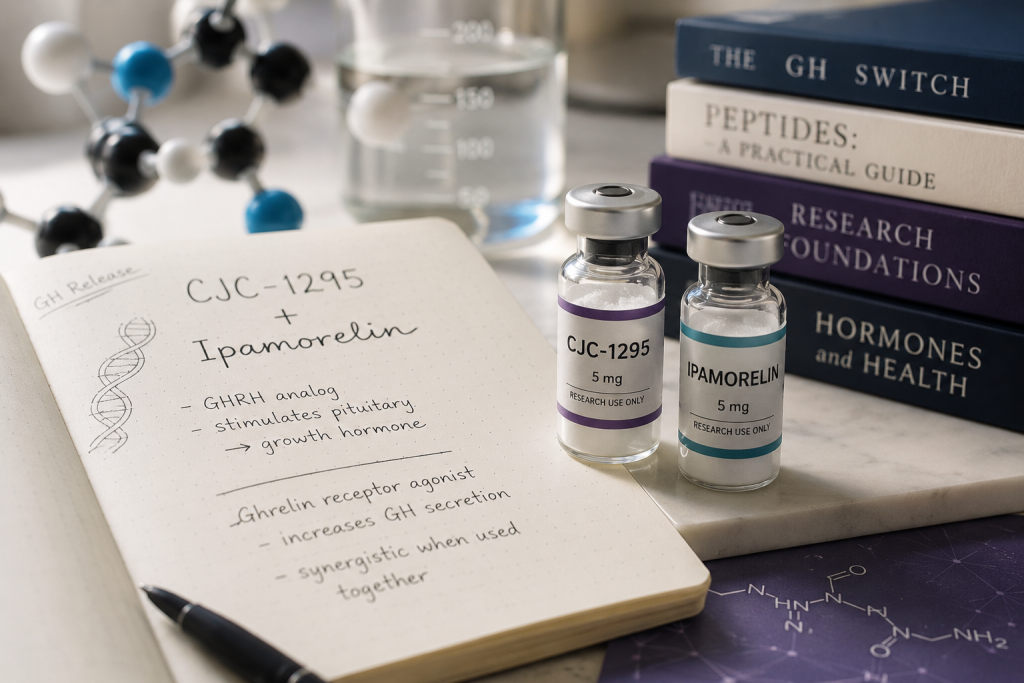
When most people hear the word peptide, they think of compounds such as BPC-157, GHK-Cu, TB-500, or growth-hormone-related peptides.
But there’s another category that operates under a very different research framework: peptide bioregulators.
These compounds are associated primarily with decades of work by Russian gerontologist Vladimir Khavinson and colleagues, who investigated extremely short peptide sequences—often only a few amino acids long—and proposed that some could influence cellular activity and gene expression.
That makes bioregulators particularly interesting because the theory behind them isn’t simply:
peptide → receptor → biological response.
Instead, much of the research asks whether very short peptides can participate in the regulation of gene expression, protein synthesis, cellular aging, and tissue-specific biological processes.
And that’s also where things get complicated.
There is published research behind the concept, including papers indexed in PubMed. But a substantial portion of the literature comes from Khavinson and collaborating research groups, and much of the older work originated in Russia. That means the evidence needs to be evaluated differently from a drug supported by large, independently replicated Western clinical trials.
So what exactly are peptide bioregulators?
What Is a Peptide Bioregulator?
Peptides are chains of amino acids.
Some peptides used in research are relatively large. Bioregulators can be extraordinarily small.
The Khavinson literature discusses short peptides containing only a handful of amino-acid residues. A 2021 systematic review from Khavinson and colleagues describes short peptides of approximately 2–7 amino acids and discusses evidence that some can enter cellular nuclei and interact with components including DNA and histone proteins.
That tiny size is part of what makes this field unusual.
Rather than functioning only as traditional signaling molecules that bind to receptors on a cell’s surface, researchers have proposed that certain short peptides may participate much further downstream—in processes associated with gene regulation.

The Idea Behind Bioregulation
Every cell contains essentially the same genetic instruction manual.
A liver cell and a neuron contain the same genome, yet they behave completely differently because different genes are switched on and off.
This regulation of gene activity is enormously complicated.
DNA methylation, histone modifications, transcription factors and other molecular mechanisms help determine which portions of DNA are accessible and which proteins a cell produces.
Researchers have investigated whether peptides can influence some of these epigenetic processes.
And this isn’t exclusively a Khavinson concept.
A 2019 review published in Clinical Epigenetics examined peptides as potential epigenetic modulators and concluded that peptides from several sources can influence mechanisms including DNA methylation, histone modification and non-coding RNA regulation. The authors also emphasized that major knowledge gaps remain.
The Khavinson bioregulator hypothesis takes this concept further.
Can Short Peptides Interact With DNA?
This is one of the most fascinating—and most debated—parts of the research.
Khavinson and colleagues have proposed that certain extremely short peptides can enter the nucleus and interact with particular DNA sequences.
The theory is that these interactions may alter the accessibility of specific genes and consequently affect transcription and protein synthesis.
A 2016 paper from the group modeled interactions between 19 short peptides and DNA and reported predicted sequence-specific binding sites for several peptides. Importantly, the authors themselves stated that the molecular mechanism through which short peptides regulate numerous genes remained unclear.
Earlier publications from the same research program proposed complementary interactions between short peptides and particular DNA sequences as one possible mechanism for regulating gene activity.
That’s a very different concept from something like ipamorelin.
Ipamorelin interacts with a known receptor.
Bioregulator research is asking whether certain tiny peptides might influence the machinery controlling which genetic instructions a cell reads in the first place.
Why Are Bioregulators Associated With Specific Organs?
This is probably what you’ll notice first when you start encountering them.
Bioregulators are commonly associated with particular tissues or biological systems.
You’ll see names connected with areas such as the:
brain and nervous system, pineal gland, thymus and immune system, cardiovascular system, liver, pancreas, cartilage, lungs, kidneys, prostate, blood vessels, and eyes.
This originated partly from earlier research involving peptide preparations derived from animal tissues.
Researchers investigated peptide fractions isolated from different organs and subsequently attempted to identify or synthesize short peptide sequences associated with their biological activity.
Over time, this produced an entire family of compounds associated with particular tissues.
Examples you’ll encounter include Pinealon, Vilon, Epitalon, Cortagen and numerous others.
But there’s an important distinction:
Calling something a “brain bioregulator” or “liver bioregulator” does not establish that it selectively repairs that organ in humans.
Those descriptions come from the experimental framework in which the peptides were developed and investigated.
They should be treated as research classifications, not guarantees of therapeutic effects.
Where Does Aging Come Into This?
Aging is central to the entire bioregulator story.
Khavinson’s research program was heavily focused on gerontology—the biology of aging.
One hypothesis behind this work is that aging involves progressive disturbances in gene regulation and protein synthesis.
If short peptides participate in maintaining normal patterns of gene expression, researchers proposed that changes in peptide regulation could contribute to age-related cellular dysfunction.
That led to investigations into whether introducing particular peptide preparations or synthetic short peptides could influence age-related biological changes.
Animal experiments and other studies from the research group reported effects involving lifespan and markers associated with age-related physiology. Reviews from the group have summarized decades of experimental work investigating peptide bioregulators as potential geroprotective compounds.
This is why you’ll frequently encounter bioregulators in longevity circles today.
Are There Human Studies?
Yes—and this is where the subject deserves more nuance than simply calling bioregulators “unproven.”
There is human literature.
A 2013 review indexed by PubMed summarized clinical work involving several peptide preparations, including Timalin, Thymogen, Vilon, Epithalamin, Prostatilen, Cortexin and Retinalamin. The authors discussed their potential applications in age-related disease and gerontology.
However, much of this research comes from the same scientific tradition and associated investigators who developed the bioregulator concept.
Bioregulators vs. the Peptides You’ve Probably Heard About
This distinction makes the entire peptide landscape easier to understand.
BPC-157 is primarily investigated in experimental models involving tissue protection and repair.
GHK-Cu is a naturally occurring copper-binding peptide investigated in areas including skin biology and tissue remodeling.
CJC-1295 acts through the growth hormone-releasing hormone pathway.
Ipamorelin acts through the ghrelin receptor.
Peptide bioregulators occupy another category entirely.
Their research centers heavily around short peptide signaling, gene expression, cellular regulation and tissue-specific biology.
They’re all peptides.
That doesn’t mean they all work the same way.
What About Epitalon?
Epitalon is probably the compound that introduces most Western peptide enthusiasts to this research.
It’s a tetrapeptide consisting of only four amino acids and is closely associated with Khavinson’s aging research.
Because Epitalon became relatively well known in longevity communities, it’s sometimes treated as though it’s an isolated anti-aging peptide.
It makes much more sense when viewed as part of the larger short-peptide bioregulation research program.
And it’s far from the only one.
There are bioregulators associated with neurological tissue, immune function, cardiovascular tissue and numerous other biological systems.
We’ll cover those individually in this library rather than lumping all of them together.
Why Haven’t Most People Heard About Them?
Part of the answer is geography.
Much of this research originated within Russian institutions and was published in Russian or Eastern European scientific literature.
That created a strange situation.
There’s substantially more published material than someone encountering bioregulators for the first time might expect, yet much of it remains relatively unfamiliar to Western researchers and clinicians.
The evidence base also doesn’t map neatly onto the modern FDA pharmaceutical-development pathway.
Consequently, searching PubMed produces a very different picture from searching social media.
One makes bioregulators look like an established field of Russian gerontology research.
The other can make them look like newly invented longevity supplements.
Neither picture tells the whole story.
Why They’re Worth Learning About
Bioregulators occupy one of the stranger corners of peptide science.
They’re not simply another collection of compounds marketed for muscle growth or recovery.
They represent a much larger scientific hypothesis:
that extremely small peptide sequences may form part of the body’s system for regulating gene activity and maintaining cellular function.
There is published research supporting pieces of that hypothesis, including evidence concerning peptide-DNA interactions and peptide-mediated epigenetic regulation.
There are also substantial gaps in independent clinical evidence.
Both facts can be true at the same time.
And that’s exactly why they’re worth covering.
Rather than treating every bioregulator as a miracle compound—or dismissing an entire research field because it developed outside mainstream Western pharmaceutical research—we can examine them individually:
What is the peptide? What tissue was it developed around? What mechanism has actually been demonstrated? What studies exist? And where does the evidence stop?
That’s what we’ll do with the bioregulators throughout the Peptide Library.
Research & Educational Disclaimer: This article is for general research and educational purposes only. It does not provide medical advice, dosing, administration instructions, or recommendations for purchasing or using peptide bioregulators. Experimental findings, proposed mechanisms and tissue associations should not be interpreted as evidence that a compound prevents, treats or cures disease in humans.