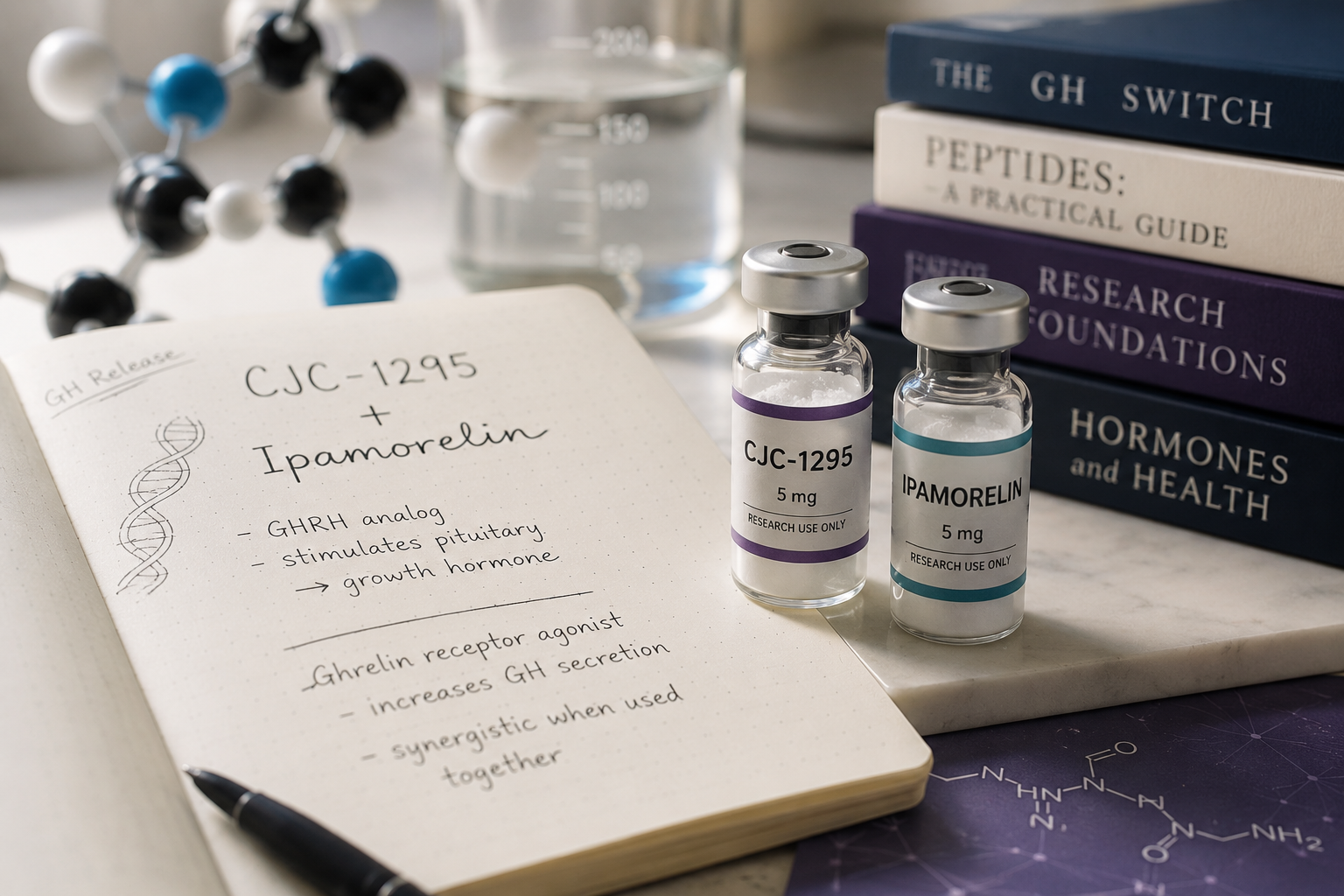
Spend five minutes browsing the peptide world and you’ll probably encounter CJC-1295 and ipamorelin as a pair.
They’re discussed together so frequently that it’s easy to assume they’re essentially two versions of the same thing. They’re not.
Both are associated with growth hormone (GH) signaling, but they approach that system through different biological pathways. That difference is the main reason researchers—and eventually the gray-market peptide community—became interested in combining them.
There is human research demonstrating that CJC-1295 can substantially increase GH and IGF-1 concentrations. Ipamorelin has also been administered to humans in clinical research and shown to stimulate GH release. What we don’t have is equally strong clinical evidence showing that the popular CJC-1295/ipamorelin combination produces the long list of body-composition, recovery, sleep, muscle-building, and anti-aging benefits commonly attributed to it online.
Understanding that distinction makes this peptide pair much easier to evaluate.
First, What Is Growth Hormone?
Growth hormone is produced by the pituitary gland and participates in far more than childhood growth.
In adults, the GH/IGF-1 system is involved in processes related to metabolism, body composition, bone and connective tissue, protein metabolism, and other aspects of normal physiology.
GH secretion isn’t constant.
The body normally releases GH in pulses, with secretion regulated by several signals. Growth hormone-releasing hormone (GHRH) stimulates GH release, while other signaling systems—including the ghrelin receptor—can also influence secretion.
CJC-1295 and ipamorelin target different parts of this system.
That’s where the pairing begins to make sense biologically.
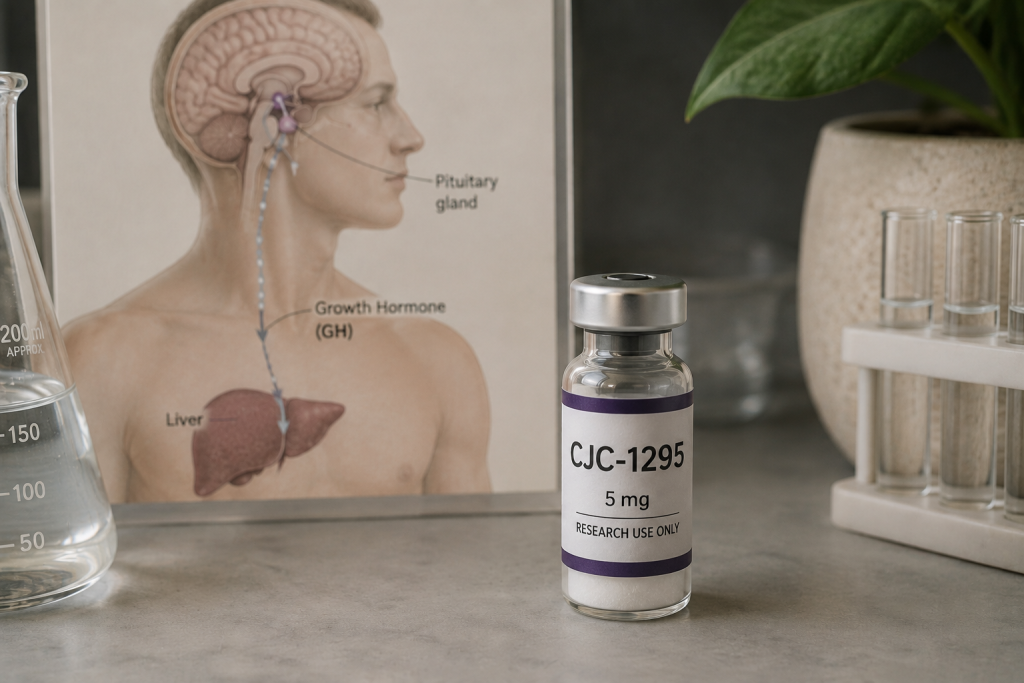
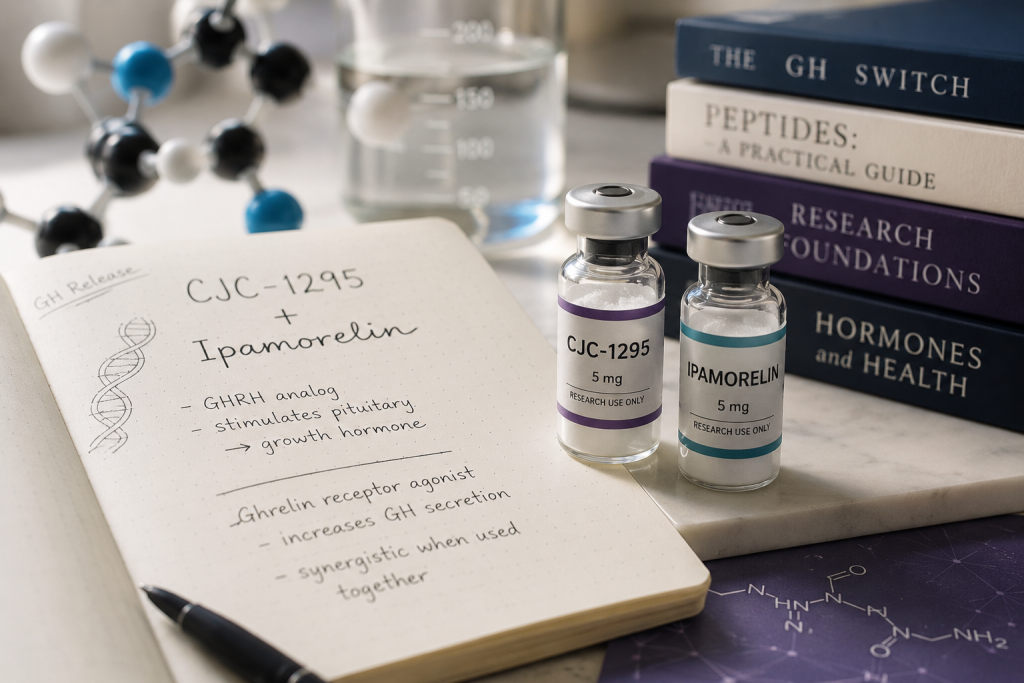
CJC-1295: Working Through the GHRH Pathway
CJC-1295 is a synthetic analog of growth hormone-releasing hormone.
Rather than being growth hormone itself, it acts upstream in the pathway that tells the pituitary to release GH.
One of the problems researchers encountered with naturally occurring GHRH was its extremely short duration in circulation. Scientists therefore developed modified molecules designed to resist degradation and remain active longer.
CJC-1295 was one of those compounds.
And unlike many research peptides circulating online today, CJC-1295 actually has published controlled human research behind it.
A randomized, placebo-controlled study published in The Journal of Clinical Endocrinology & Metabolism evaluated CJC-1295 in healthy adults.
Following a single administration, researchers observed dose-dependent increases in average GH concentrations of approximately 2- to 10-fold, which persisted for six days or longer.
IGF-1 concentrations increased approximately 1.5- to 3-fold and remained elevated for roughly 9–11 days.
Researchers estimated the compound’s half-life at approximately 5.8 to 8.1 days.
Those are meaningful human pharmacology findings.
But there’s a catch.
The CJC-1295 Naming Problem
If you’re researching CJC-1295 online, you’ll encounter two labels almost immediately:
CJC-1295 with DAC
and
CJC-1295 without DAC.
That terminology makes it sound as though someone simply removed an optional ingredient from the same peptide.
The reality is more complicated.
The CJC-1295 studied in the well-known human trial was designed with a Drug Affinity Complex, or DAC, that allows it to bind to albumin and remain in circulation much longer. That’s responsible for its unusually prolonged activity.
What the peptide market commonly calls “CJC-1295 without DAC” is generally referring to a short-acting modified GHRH analog commonly known as Modified GRF (1-29).
You’ll see the names used interchangeably all over the internet.
For someone reading the research, that’s a problem.
A study demonstrating that long-acting CJC-1295 remains active for several days should not automatically be used to describe the pharmacokinetics of a product labeled “CJC-1295 no DAC.”
When reading any CJC-1295 study, therefore, one of the first questions should be:
Which molecule was actually studied?
What Is Ipamorelin?
Ipamorelin approaches GH signaling differently.
It is a growth hormone secretagogue that acts through the growth hormone secretagogue receptor, now commonly known as the ghrelin receptor (GHS-R1a).
Rather than mimicking GHRH signaling, ipamorelin activates another pathway capable of stimulating GH secretion.
Ipamorelin was originally investigated because researchers were interested in developing growth-hormone secretagogues with greater selectivity.
And yes—ipamorelin has been studied in humans.
A randomized clinical study published in 1999 evaluated its pharmacokinetics and pharmacodynamics in healthy male volunteers across several intravenous infusion levels.
The researchers observed a clear relationship between ipamorelin exposure and GH response, demonstrating that the peptide was capable of stimulating GH secretion in humans.
That’s useful evidence for its mechanism.
It doesn’t establish that ipamorelin improves muscle growth, fat loss, recovery, sleep, longevity, or athletic performance.
Those are separate questions requiring separate clinical evidence.
So Why Put CJC-1295 and Ipamorelin Together?
This is where the science becomes interesting.
CJC-1295 and ipamorelin influence the GH system through different receptor pathways.
CJC-1295 is associated with GHRH-receptor signaling.
Ipamorelin is associated with ghrelin-receptor signaling.
That creates a plausible rationale for studying the two pathways together rather than simply increasing stimulation through one pathway.
But there’s an important line we shouldn’t cross:
A biologically plausible combination is not the same thing as a clinically proven combination.
The human CJC-1295 research generally studied CJC-1295.
The early human ipamorelin research studied ipamorelin.
That doesn’t automatically tell us what happens when gray-market formulations of the two are combined.
This is one of the most common ways peptide claims become inflated online: evidence from two individual compounds gets combined into evidence for a combination that wasn’t actually tested in the cited studies.
What About Muscle Growth?
This is probably one of the biggest reasons the combination gets attention.
The reasoning usually goes something like this:
CJC-1295 can increase GH and IGF-1.
Ipamorelin can stimulate GH secretion.
GH and IGF-1 participate in processes related to growth and metabolism.
Therefore, CJC-1295 + ipamorelin must build muscle.
There’s a missing step.
Showing that a compound changes a hormone concentration does not automatically demonstrate a meaningful clinical outcome.
The CJC-1295 human study measured GH and IGF-1 concentrations. It was not a bodybuilding trial designed to establish increases in muscle mass or strength.
That’s an important distinction because marketing frequently takes a demonstrated biological effect and presents a downstream theoretical benefit as though researchers demonstrated both.
They didn’t.
And Fat Loss?
The same issue applies.
Growth hormone participates in metabolic processes, including lipid metabolism. That provides a biological reason researchers might be interested in how GH-modulating compounds affect body composition.
But again:
Mechanism ≠ demonstrated outcome.
Evidence that CJC-1295 elevates GH and IGF-1 does not, by itself, prove that CJC-1295—or CJC-1295 combined with ipamorelin—produces clinically meaningful fat loss.
That’s a hypothesis requiring controlled outcome studies.
It’s not something we can simply infer from a hormone level.
What About Recovery?
“Recovery” is an especially slippery term in peptide marketing.
It can mean almost anything:
Muscle soreness. Exercise performance. Injury healing. Sleep. Energy. Connective-tissue repair. Training capacity.
Because GH and IGF-1 participate in normal tissue physiology, compounds affecting this axis are understandably interesting to researchers.
But saying a compound affects the GH/IGF-1 pathway is very different from demonstrating that it accelerates recovery from exercise or injury in humans.
For comparison, BPC-157 and TB-500 discussions frequently center on direct experimental models of tissue injury.
CJC-1295 and ipamorelin are primarily interesting because of their endocrine effects.
Those shouldn’t be treated as interchangeable bodies of evidence.
Does the Combination Improve Sleep?
This is another popular claim.
Normal GH secretion has a relationship with sleep, particularly slow-wave sleep, and major GH pulses normally occur during the night.
That creates an interesting connection between the two physiological systems.
However, it doesn’t mean that artificially increasing GH secretion has been demonstrated to improve sleep quality.
The available human CJC-1295 pharmacology research demonstrates prolonged GH and IGF-1 elevation. It does not establish CJC-1295/ipamorelin as a treatment for insomnia or poor sleep.
It’s another example of a plausible biological connection becoming a much stronger consumer claim.
More GH Isn’t Automatically Better
This point gets lost frequently.
Growth hormone and IGF-1 are powerful signaling molecules precisely because they influence so many tissues.
That doesn’t mean pushing those signals higher indefinitely is inherently beneficial.
Endocrine systems are regulated for a reason.
When evaluating peptides that alter hormonal signaling, the question shouldn’t simply be:
“Does it increase growth hormone?”
We already have evidence that CJC-1295 does.
The more important questions are:
What clinical outcome does that change produce?
At what level of exposure?
For how long?
In which population?
And what happens to safety when the pathway is repeatedly altered?
Those questions require much more evidence.
What Do We Know About Safety?
This deserves more attention than it usually receives.
In the early controlled CJC-1295 study, no serious adverse reactions were reported, and the investigators described the compound as relatively well tolerated under the conditions studied.
That does not establish long-term safety.
The trials were relatively short, and CJC-1295 never progressed into an approved medication with the extensive clinical development and post-market surveillance available for established drugs.
The FDA currently states that compounded drugs containing CJC-1295 may present immunogenicity and peptide-impurity concerns. The agency also says available clinical data are limited and notes serious adverse events associated with CJC-1295, including increased heart rate and a systemic vasodilatory reaction.
Ipamorelin has its own uncertainties.
FDA likewise notes potential immunogenicity and characterization concerns for compounded ipamorelin acetate. The agency states that it lacks sufficient safety information for certain injectable routes. It also cites serious adverse events from a study in which intravenous ipamorelin was investigated for gastric motility—although that setting and route should not simply be equated with every other proposed use of the compound.
So “it stimulates your body’s own GH” should not be interpreted as “therefore it is inherently safe.”
Those are two different claims.
Are CJC-1295 and Ipamorelin FDA Approved?
Neither CJC-1295 nor ipamorelin is an FDA-approved drug for the recovery, anti-aging, muscle-building, fat-loss, or wellness purposes for which they’re commonly promoted.
That matters because FDA approval involves considerably more than determining whether a molecule has an interesting biological effect.
Researchers need evidence concerning effectiveness, adverse effects, manufacturing consistency, dosing, interactions, pharmacology, and risk-benefit balance for a particular indication.
Gray-market availability doesn’t replace that process.
FDA currently specifically flags both CJC-1295 and ipamorelin acetate among bulk substances that may present significant safety risks when used in compounding.
The Biggest Takeaway
CJC-1295 and ipamorelin aren’t scientifically interesting because someone on social media decided to call them a “stack.”
They’re interesting because they interact with two different components of the biological system controlling growth-hormone secretion.
And unlike some compounds circulating in the peptide market, both have at least some human pharmacology data.
CJC-1295 has particularly clear evidence demonstrating prolonged increases in GH and IGF-1 concentrations in healthy adults. Ipamorelin has human pharmacokinetic/pharmacodynamic research demonstrating stimulation of GH secretion.
Where the evidence becomes much weaker is when those findings turn into claims that the combination has been proven to:
build muscle,
burn fat,
accelerate injury recovery,
improve sleep,
reverse aging,
or optimize human performance.
Those outcomes require evidence of their own.
And there’s one more detail worth remembering whenever you encounter CJC-1295 research:
“CJC-1295 with DAC” and the compound commonly marketed as “CJC-1295 without DAC” should not automatically be treated as the same thing.
For a research resource, getting those distinctions right is far more useful than repeating the promises found on a product page.
Research & Educational Disclaimer
This article is intended for general educational and research purposes only. It does not provide medical advice or instructions for purchasing, combining, dosing, injecting, or otherwise using CJC-1295, ipamorelin, or other research peptides. Neither compound is FDA approved for the wellness and performance uses discussed above. Hormonal manipulation can carry meaningful risks, and questions about medical treatment should be discussed with an appropriately licensed healthcare professional.
Research Sources
Human randomized CJC-1295 study — PubMed