Welcome to WordPress. This is your first post. Edit or delete it, then start writing!
Peptide Profiles
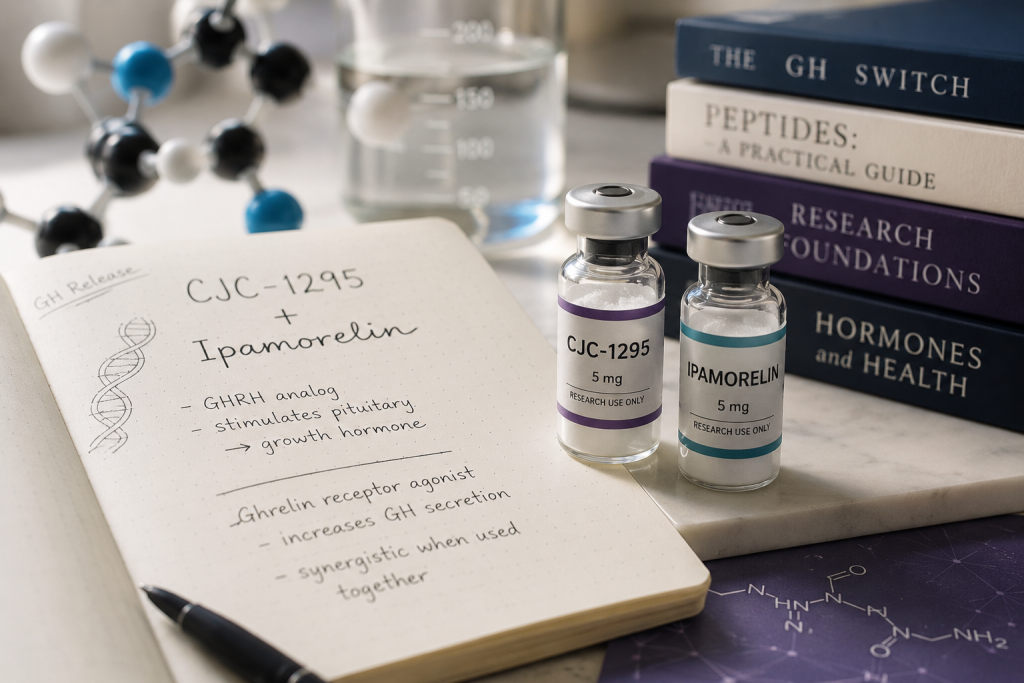
CJC-1295 & Ipamorelin: Why These Two Peptides Are Often Discussed Together
Spend five minutes browsing the peptide world and you’ll probably encounter CJC-1295 and ipamorelin as a pair.
They’re discussed together so frequently that it’s easy to assume they’re essentially two versions of the same thing. They’re not.
Both are associated with growth hormone (GH) signaling, but they approach that system through different biological pathways. That difference is the main reason researchers—and eventually the gray-market peptide community—became interested in combining them.
There is human research demonstrating that CJC-1295 can substantially increase GH and IGF-1 concentrations. Ipamorelin has also been administered to humans in clinical research and shown to stimulate GH release. What we don’t have is equally strong clinical evidence showing that the popular CJC-1295/ipamorelin combination produces the long list of body-composition, recovery, sleep, muscle-building, and anti-aging benefits commonly attributed to it online.