BPC-157 has become one of the most talked-about compounds in the peptide research world, particularly in conversations surrounding tissue repair, tendons, ligaments, gastrointestinal research, and recovery.
But its online reputation has moved considerably faster than the clinical evidence.
Most of what scientists currently know about BPC-157 comes from preclinical research, including laboratory and animal studies. Human research exists, but it remains small and preliminary. A 2025 systematic review examining its use in orthopedic and sports-medicine research found 36 eligible studies—35 were preclinical and only one was clinical.
So what exactly is BPC-157, and what does the research actually tell us?
What Is BPC-157?
BPC-157 is a synthetic peptide consisting of 15 amino acids. It is commonly described in scientific literature as a gastric pentadecapeptide derived from a protein fragment associated with gastric juice.
Researchers have investigated BPC-157 across a surprisingly broad range of experimental models, but much of the attention surrounding it today centers on its potential involvement in tissue protection and repair.
That includes research involving:
- Tendons and ligaments
- Skeletal muscle
- Bone and joints
- Blood-vessel formation
- Gastrointestinal tissues
- Inflammatory pathways
This doesn’t mean BPC-157 has been demonstrated to treat injuries or diseases in humans. It means researchers have observed biological effects worth investigating further.
And that distinction is important.
Why Is BPC-157 Associated With Tissue Repair?
This is where the research gets interesting.
Animal and laboratory studies have reported effects involving several biological processes associated with healing and tissue recovery.
One area receiving particular attention is angiogenesis, the process through which new blood vessels develop from existing ones. Researchers have also investigated BPC-157’s interactions with growth-factor signaling, inflammatory pathways, nitric-oxide systems, fibroblast activity, and collagen-related processes.
These mechanisms could theoretically help explain some of the tissue-repair effects observed in experimental models.
But biological plausibility isn’t the same thing as demonstrated clinical effectiveness.
BPC-157 and Tendon Research
Tendons are particularly interesting from a research perspective because they can be frustratingly slow to heal.
Their relatively limited blood supply compared with many other tissues is one reason researchers continue investigating new approaches to tendon repair.
BPC-157 has been examined in animal models involving tendon injuries, and reviews of the literature have reported improvements in structural, functional, and biomechanical outcomes in several preclinical models. Similar research has investigated ligament and muscle injuries.
These findings are largely responsible for BPC-157’s reputation within the recovery and sports communities.
However, evidence from an animal tendon model cannot establish that the same result will occur in an injured human tendon.
What About Joints?
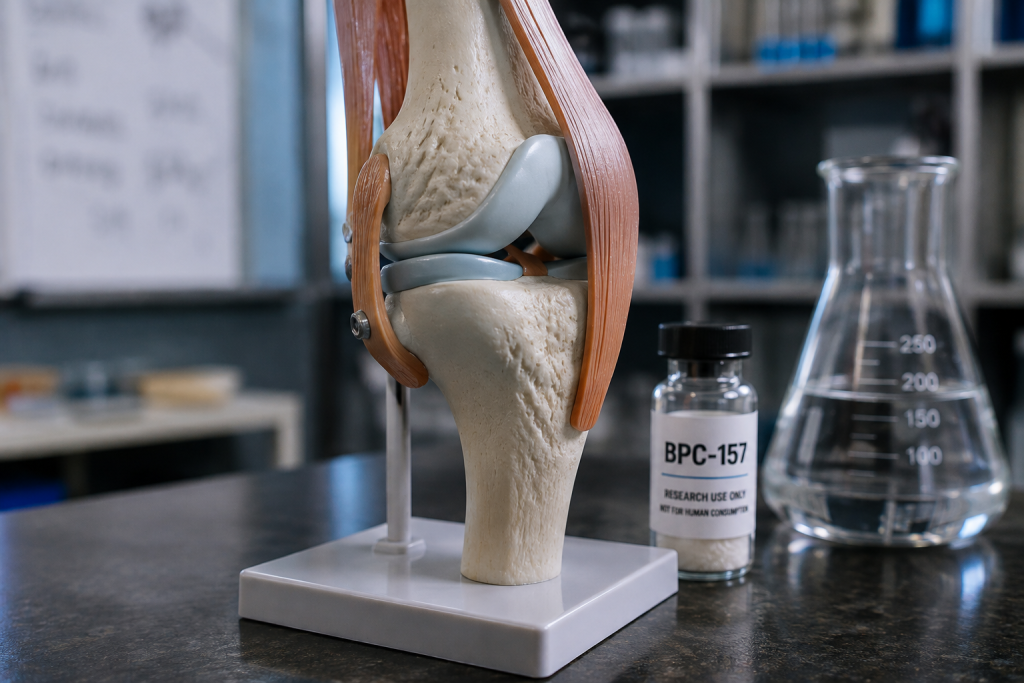
There is a small amount of human research involving BPC-157 and knee pain.
A retrospective study included in a 2025 systematic review examined people receiving intra-articular BPC-157 for chronic knee pain. Among the patients evaluated, some reported prolonged improvement in pain.
There were major limitations, however.
The study was small, uncontrolled, and methodologically limited. Researchers reviewing the evidence have specifically cautioned that results from this study aren’t enough to establish BPC-157 as an effective treatment for musculoskeletal injuries.
This is a good example of why the phrase “human study” doesn’t automatically mean “proven in humans.”
Study design matters enormously.
BPC-157 and the Gastrointestinal System
BPC-157 research didn’t begin with gym injuries.
The peptide has long been investigated in relation to the gastrointestinal system, and animal models have examined its effects on gastric and intestinal tissue, mucosal protection, inflammation, and injury.
Researchers have proposed several pathways that could contribute to these observations, including effects involving nitric oxide, blood-vessel signaling, inflammatory responses, and cellular protection.
Human evidence remains limited here as well.
In July 2026, the FDA reviewed BPC-157-related substances in connection with a nomination for pharmacy compounding and specifically evaluated evidence concerning ulcerative colitis. The agency concluded that there was insufficient evidence supporting its effectiveness for that use and noted that the available clinical evidence was extremely limited.
Does BPC-157 Reduce Inflammation?
Preclinical studies have reported changes in inflammatory signaling associated with BPC-157.
Researchers have investigated effects involving inflammatory cytokines and pathways involved in cellular stress and tissue injury.
That makes inflammation another important area of BPC-157 research.
It does not, however, mean that BPC-157 has been clinically demonstrated to treat inflammatory diseases in humans.
That’s a much higher evidentiary bar.
What Human Research Exists?
This is where online discussions about BPC-157 often become misleading.
Human research does exist—but there isn’t much of it.
An FDA scientific review published for its 2026 Pharmacy Compounding Advisory Committee identified several very small human investigations involving BPC-157, including research involving ulcerative colitis, knee pain, interstitial cystitis and intravenous administration.
The studies generally involved small numbers of participants and limited safety monitoring. The FDA concluded that the available information was insufficient to establish safety for the proposed routes of administration.
One 2025 pilot study examined intravenous BPC-157 in only two healthy adults. No adverse effects were reported during the study, but two participants obviously cannot establish the safety of a compound across a larger population.
A 2026 review similarly concluded that BPC-157 remains pharmaceutically underdeveloped, with no validated dosing regimen and no completed Phase II clinical trial.
Is BPC-157 FDA Approved?
No.
BPC-157 is not an FDA-approved drug.
That distinction is particularly important because research compounds are frequently discussed online using language that makes them sound like established medications.
They aren’t interchangeable concepts.
FDA approval requires evidence regarding manufacturing quality, safety and effectiveness for specific medical indications. BPC-157 has not gone through that process successfully.
The FDA has also raised concerns regarding BPC-157 in compounding, including potential immunogenicity, peptide-related impurities and difficulties surrounding characterization of the active pharmaceutical ingredient. The agency states that available safety information is insufficient to determine whether administration could cause harm in humans.
The Biggest Problem With BPC-157 Research
The biggest issue isn’t that there’s no interesting science.
There is.
The problem is the enormous gap between what experimental research suggests and what internet discussions often claim has already been proven.
Animal studies provide valuable information. They help scientists identify mechanisms worth investigating and compounds that might eventually warrant clinical development.
But successful animal research is only one step.
Researchers still need properly designed human trials to determine questions such as safety, effectiveness, pharmacokinetics, adverse effects and whether observed benefits actually outperform placebo or existing treatments.
For BPC-157, those answers remain incomplete.
So, Is BPC-157 Promising?
From a research perspective?
Potentially.
Preclinical evidence involving tissue repair, gastrointestinal protection, vascular signaling and inflammatory pathways makes BPC-157 scientifically interesting. Recent systematic reviews continue to describe promising findings in musculoskeletal models.
But promising and proven are two very different words.
At present, human evidence remains sparse, clinical safety hasn’t been adequately established, standardized pharmaceutical preparations are lacking, and BPC-157 is not FDA approved.
That’s the most accurate way to describe the state of the research.
And it’s also why BPC-157 is such an interesting compound to continue watching.
Research & Educational Disclaimer
This article is provided for general educational and research purposes only. It is not medical advice and should not be interpreted as a recommendation to purchase, administer, dose, or use BPC-157. BPC-157 is not FDA approved for human use. Research findings—particularly findings from laboratory and animal studies—do not establish safety or effectiveness in humans. Consult an appropriately licensed healthcare professional regarding medical conditions or treatment decisions.
Research Sources
2025 systematic review of BPC-157 in orthopedic sports medicine — PubMed
FDA review of BPC-157 safety and clinical evidence
FDA information on safety concerns involving BPC-157 bulk drug substances
2026 review of BPC-157 development and translational evidence — PubMed