GHK-Cu is one of the more established names in peptide research. Unlike many compounds that have only recently gained attention online, the science surrounding GHK-Cu stretches back decades.
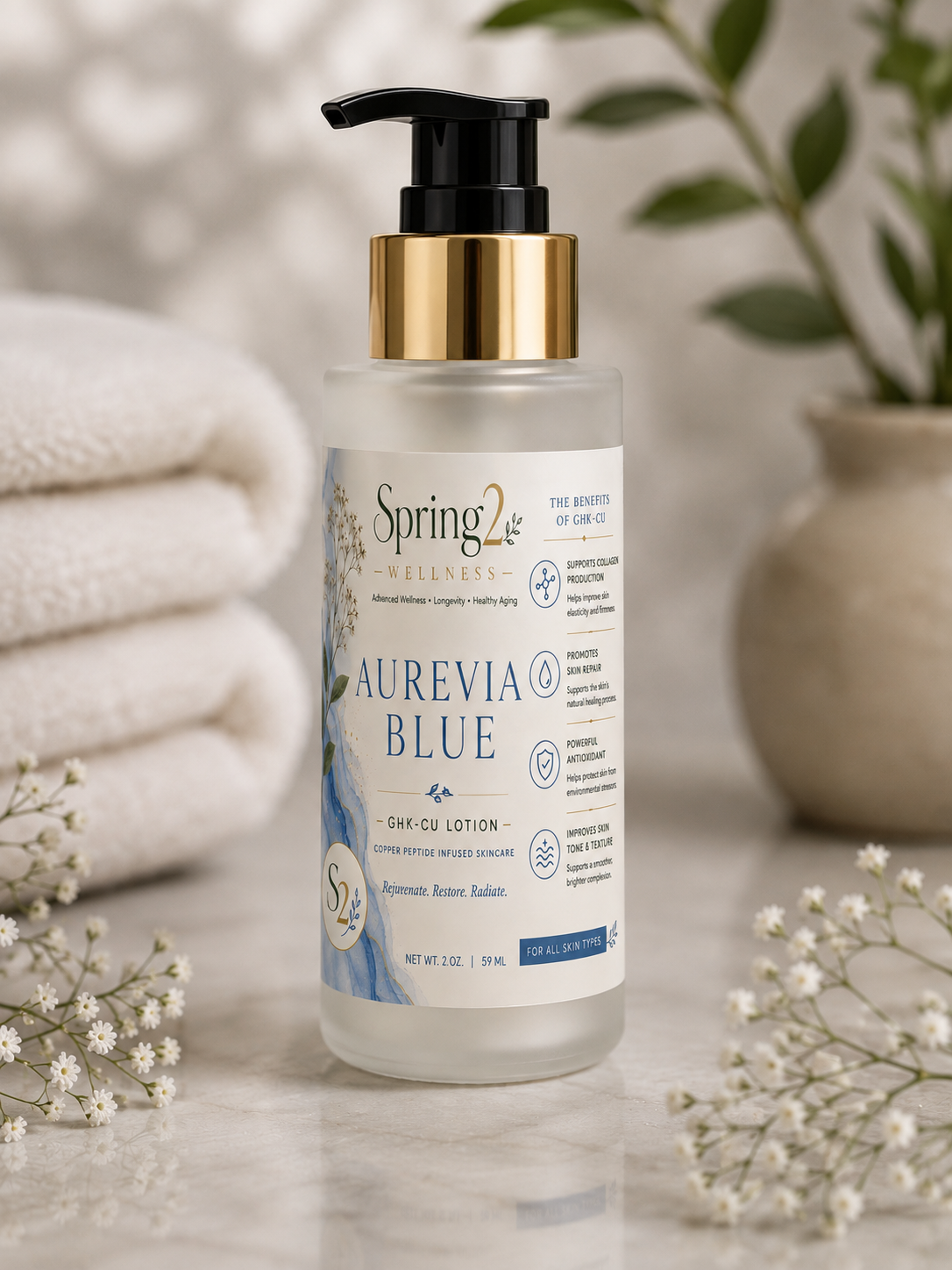
It is particularly well known in cosmetic science, where copper peptides appear in products marketed for aging skin, skin texture, and hair care. But GHK-Cu has also been investigated in laboratory and preclinical research involving wound healing, inflammation, collagen production, tissue remodeling, and cellular signaling.
There is an important distinction, though: the evidence isn’t equally strong for all of those claims.
Topical skin research is considerably more developed than research supporting many of the systemic or injectable claims now associated with GHK-Cu.
What Is GHK-Cu?
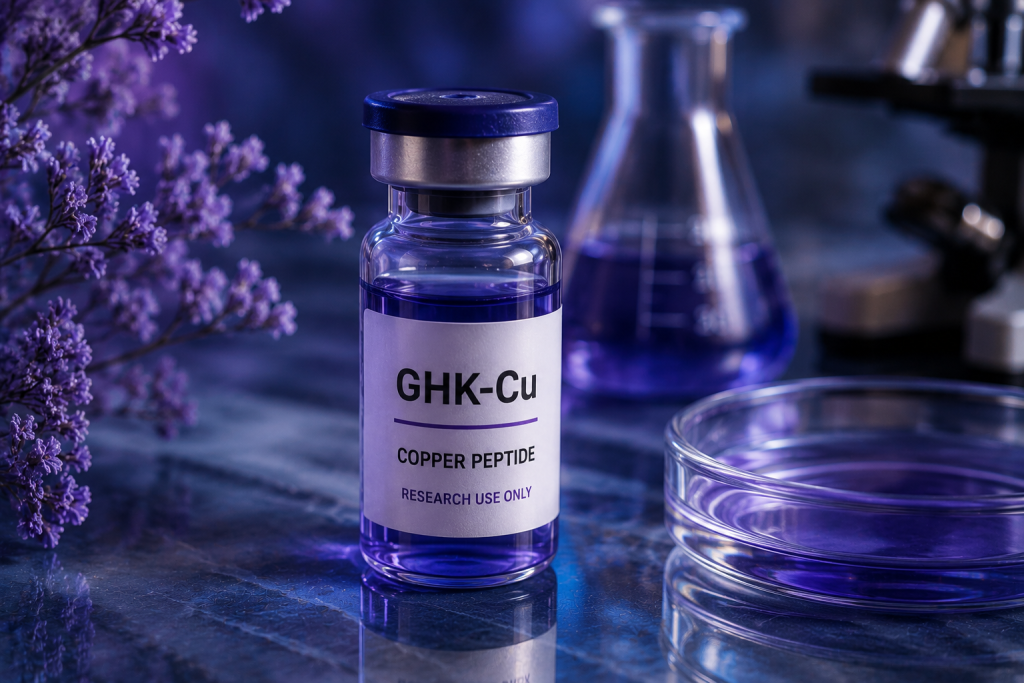
GHK stands for glycyl-L-histidyl-L-lysine, a naturally occurring tripeptide made from three amino acids: glycine, histidine, and lysine.
GHK has a strong affinity for copper ions. When it binds copper, it forms the complex generally known as GHK-Cu.
The peptide was first identified in human plasma in the 1970s and has since been found in other biological fluids and tissues. Researchers have spent decades investigating its potential role in tissue maintenance and repair.
Copper itself is involved in several biological processes, including connective-tissue formation and enzyme activity. GHK appears to provide a biological mechanism for binding and transporting copper while also participating in cellular signaling.
That combination is part of what makes GHK-Cu scientifically interesting.
Why Is GHK-Cu Associated With Skin?
Skin is probably where GHK-Cu has its strongest reputation—and where some of the more meaningful human evidence exists.
Healthy skin depends heavily on its extracellular matrix, which contains structural proteins including collagen and elastin.
As skin ages, collagen production and organization change. Environmental factors such as ultraviolet exposure can contribute to additional structural damage.
GHK-Cu has been investigated for its ability to influence fibroblasts—the cells responsible for producing many of the components of the extracellular matrix.
Laboratory research has reported effects involving collagen and elastin production, fibroblast activity, matrix-remodeling enzymes, and other processes involved in maintaining skin structure.
What Does Human Skin Research Look Like?
This is one area where we can move beyond animal research.
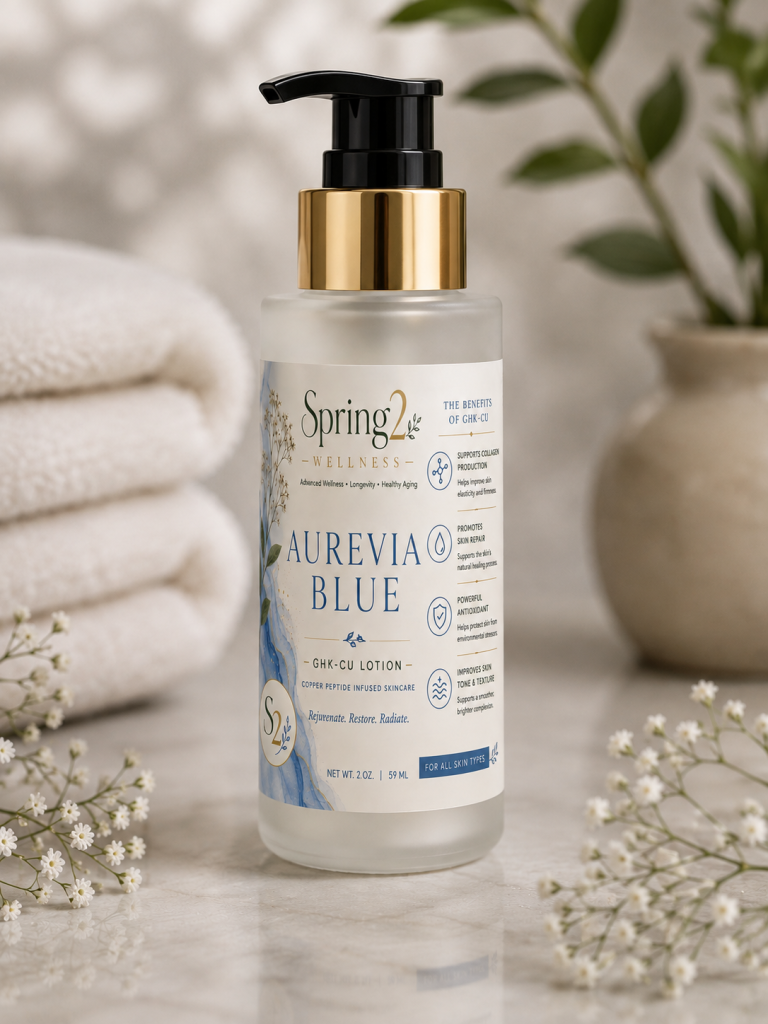
Several small clinical studies have investigated topical GHK-Cu-containing products in aging or photodamaged skin.
A review of the research describes a 12-week study involving 71 women in which a GHK-Cu facial cream was associated with improvements in measures including skin density, thickness, laxity, clarity, fine lines, and wrinkle depth.
Another 12-week study involving 41 women examined a GHK-Cu eye cream and reported improvements in lines, wrinkles, skin density, and thickness compared with control treatments.
Other research has reported increased collagen production and improvements in skin elasticity and texture following topical application.
That’s much more substantial than saying a compound produced an interesting result in a dish of cells.
But there are still limitations.
The studies are generally small and relatively short, and some of the older literature has methodological or commercial-interest limitations. A recent evidence assessment classified the evidence for cutaneous tissue repair as low certainty, despite the encouraging findings.
So there is legitimate human evidence—but it shouldn’t be exaggerated.
GHK-Cu and Collagen
Collagen is one of the reasons copper peptides became so prominent in skincare.
Collagen provides structural support throughout the body and is particularly important in skin, tendons, ligaments, cartilage, and other connective tissues.
Research has demonstrated that GHK-Cu can influence fibroblast activity and collagen-related processes.
More recent laboratory work continues to explore this effect. A 2023 study investigating GHK-Cu alongside hyaluronic acid found increased expression of several collagen types in human dermal fibroblasts and subsequently examined the combination in an ex-vivo skin model.
That doesn’t mean GHK-Cu simply “creates collagen” wherever it is applied.
Rather, the available research suggests it can influence cellular pathways involved in extracellular-matrix production and remodeling.
GHK-Cu and Wound Healing
GHK-Cu’s connection with wound healing is another major part of its research history.
Healing damaged tissue requires a coordinated sequence of events involving inflammation, immune cells, fibroblasts, blood-vessel formation, collagen deposition, and eventually remodeling of the repaired tissue.
GHK-Cu has been investigated across several of these processes.
Research reviews describe effects involving recruitment of repair-related cells, fibroblast and keratinocyte proliferation, angiogenesis, collagen and elastin production, and modulation of inflammatory processes.
Animal and laboratory evidence in this area is substantial compared with many newer research peptides.
The human evidence, however, remains much thinner.
A recent review of regenerative peptide therapies noted that although GHK-Cu has decades of tissue-remodeling and wound-healing research behind it, large-scale clinical studies in humans remain scarce.
That’s another case where the biological evidence is compelling enough to justify continued research without establishing every claim made about the compound.
What About Inflammation?
Inflammation is necessary for healing.
The problem occurs when inflammatory processes become excessive or remain active longer than necessary.
Research has suggested that GHK-Cu can influence several pathways associated with inflammation and oxidative stress. Reviews describe effects involving inflammatory mediators, antioxidant activity, and cellular responses to injury.
These properties may partly explain why the peptide has produced interesting results in tissue-repair models.
However, this does not mean GHK-Cu has been clinically established as a treatment for inflammatory diseases.
Mechanistic evidence and clinical effectiveness are different things.
GHK-Cu and Hair Research
Hair is where things get particularly interesting—and where it’s easy for marketing to get ahead of the evidence.
Hair follicles are complex miniature organs that continuously cycle through growth, regression, and resting phases.
Because GHK-Cu influences processes involving fibroblasts, extracellular-matrix remodeling, inflammation, and tissue signaling, researchers have investigated whether copper peptides could also influence hair-follicle biology.
There are experimental findings suggesting potential effects on hair follicles.
But the evidence for GHK-Cu specifically causing meaningful human hair regrowth is much weaker than its reputation online might suggest.
One frequently cited copper-peptide study, for example, demonstrated stimulation of human hair follicles ex vivo and dermal papilla cells in culture—but the compound studied was AHK-Cu, not GHK-Cu.
That distinction matters.
The two are related copper-binding peptides, but evidence involving one shouldn’t automatically be presented as proof for the other.
At present, GHK-Cu’s skin research is considerably stronger than the evidence establishing it as a human hair-growth treatment.
GHK-Cu and Tissue Remodeling
One of the more interesting ways to think about GHK-Cu isn’t simply as a “skin peptide.”
It’s as a molecule involved in tissue remodeling.
After tissue is damaged, the body doesn’t merely fill the damaged area with new material. It has to coordinate inflammation, cellular recruitment, blood-vessel development, extracellular-matrix production, and eventually remodeling of that new tissue.
Research suggests GHK-Cu can interact with several parts of that process.
A review published in the Journal of Biomaterials Science described effects involving repair-cell recruitment, collagen and elastin production, fibroblast and keratinocyte proliferation, angiogenesis, and multiple growth-factor-related processes.
That helps explain why the same small peptide appears in research involving seemingly unrelated areas such as skin aging and wound repair.
The common thread is regeneration and remodeling of tissue.
Does GHK-Cu Affect Gene Expression?
This is another area that has attracted a lot of attention.
Researchers analyzing gene-expression databases have reported that GHK can influence the expression of numerous genes associated with biological processes such as tissue repair, inflammation, oxidative stress, and cellular function.
You’ll sometimes see this transformed online into claims that GHK-Cu can “reset your genes” or reverse biological aging.
That’s a much bigger claim than the evidence supports.
Changes in gene expression are scientifically interesting, but they don’t automatically translate into a demonstrated anti-aging treatment in humans.
This is exactly why understanding the difference between mechanism and clinical outcome matters.
Topical GHK-Cu vs. Injectable GHK-Cu
These should not be treated as equivalent.
Most of the recognizable human evidence surrounding GHK-Cu involves topical formulations and skin-related outcomes.
Injectable GHK-Cu is a very different proposition.
Evidence reviews note that large-scale human clinical evidence for injected GHK-Cu is lacking, despite increasing interest in systemic use.
A compound having evidence as an ingredient in a topical cosmetic doesn’t establish that injecting the same molecule is safe or produces the same effects.
Route of administration matters.
It changes exposure, metabolism, pharmacokinetics, potential adverse effects, and the level of evidence necessary to establish safety.
Why Is GHK-Cu Different From Many Research Peptides?
GHK-Cu occupies an unusual position.
It isn’t simply a newly synthesized compound that suddenly became popular online.
It’s a naturally occurring human peptide complex with decades of biological research and some human topical data behind it.
That gives GHK-Cu a more developed scientific foundation than many compounds commonly discussed in the research-peptide space.
But it doesn’t make every modern claim about GHK-Cu true.
There is a major difference between:
“GHK-Cu has evidence supporting effects on skin biology and tissue-remodeling pathways”
and
“GHK-Cu has been proven to regenerate the human body, regrow hair, reverse aging, and heal injuries.”
The first statement reflects published research.
The second leaps far beyond it.
Where Does the Evidence Stand?
GHK-Cu is genuinely interesting.
There is evidence supporting its biological involvement in collagen production, extracellular-matrix remodeling, fibroblast activity, wound-repair processes, and inflammatory signaling.
There are also small human studies supporting potential benefits from topical copper-peptide formulations for aging and photodamaged skin.
Evidence for human hair growth is considerably weaker.
And claims involving systemic or injectable GHK-Cu move even further beyond the established clinical evidence.
So GHK-Cu gives us a great example of something we’ll encounter repeatedly in peptide research:
The science can be legitimate while the marketing is still exaggerated.
Understanding where one ends and the other begins is the important part.
Research & Educational Disclaimer
This article is provided for general educational and research purposes only. It is not medical advice and should not be interpreted as a recommendation to purchase, administer, inject, dose, or otherwise use GHK-Cu or another research compound. Laboratory, animal, ex-vivo, and mechanistic findings do not by themselves establish safety or effectiveness in humans. Questions involving medical conditions or treatment should be discussed with an appropriately licensed healthcare professional.
Research Sources
GHK-Cu and tissue remodeling — PubMed
Regenerative and Protective Actions of GHK-Cu — PMC
2026 review of copper peptides in regenerative aesthetic dermatology
GHK-Cu and hyaluronic acid collagen research
Review of peptide therapies for soft-tissue regeneration — PMC