
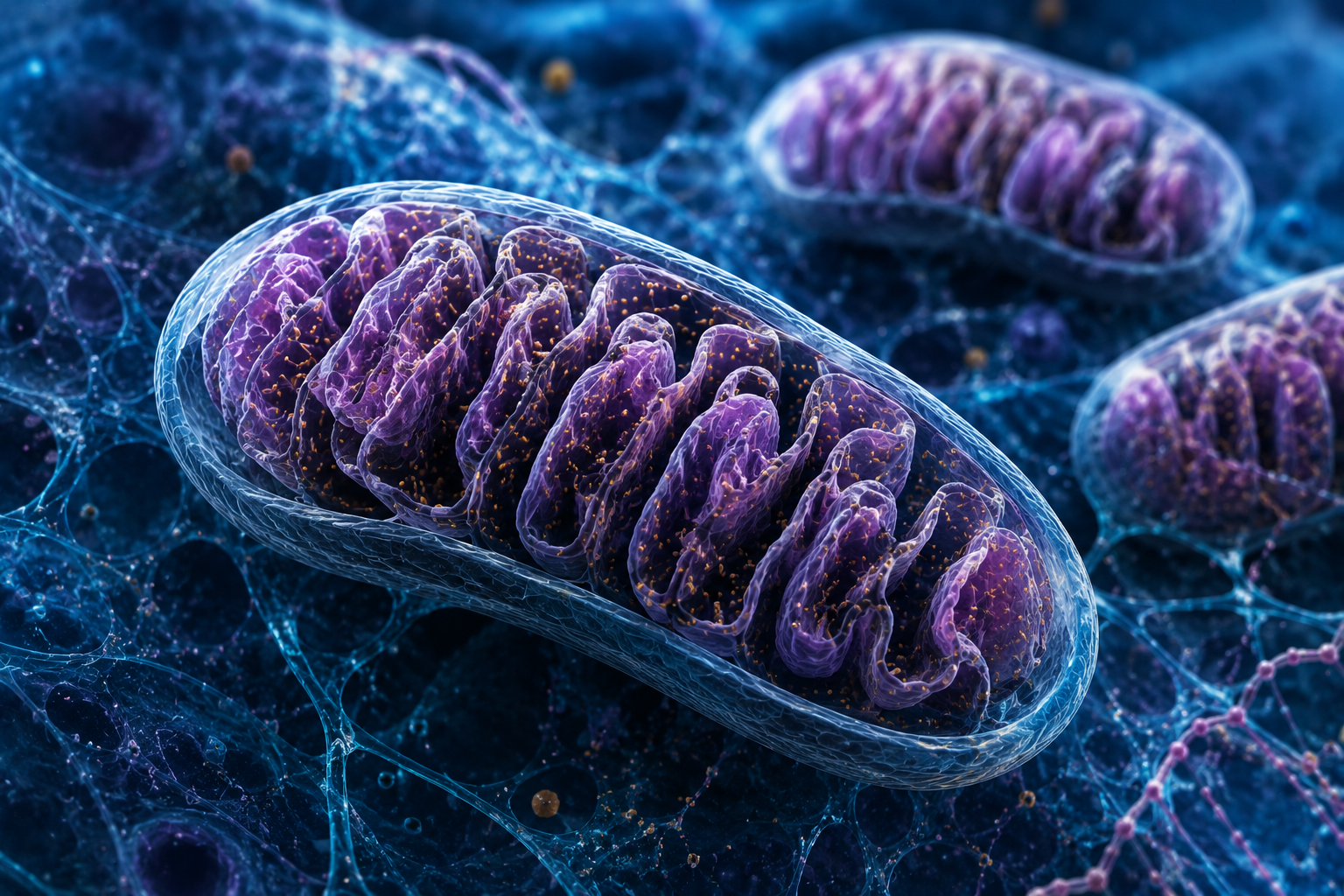
Most peptides are encoded by DNA inside the cell’s nucleus.
MOTS-c is different.
Its genetic instructions are found within mitochondrial DNA—the small, separate genome carried inside our mitochondria.
That alone makes MOTS-c unusual.
But what researchers discovered afterward made it considerably more interesting.
MOTS-c appears to participate in communication between the mitochondria and the rest of the cell. Research has connected it with metabolic regulation, insulin sensitivity, cellular stress responses, skeletal muscle, exercise and aging.
Even more intriguing, humans appear to naturally produce more MOTS-c in response to exercise.
So what exactly is this tiny mitochondrial peptide—and how much of the excitement surrounding it is actually supported by research?
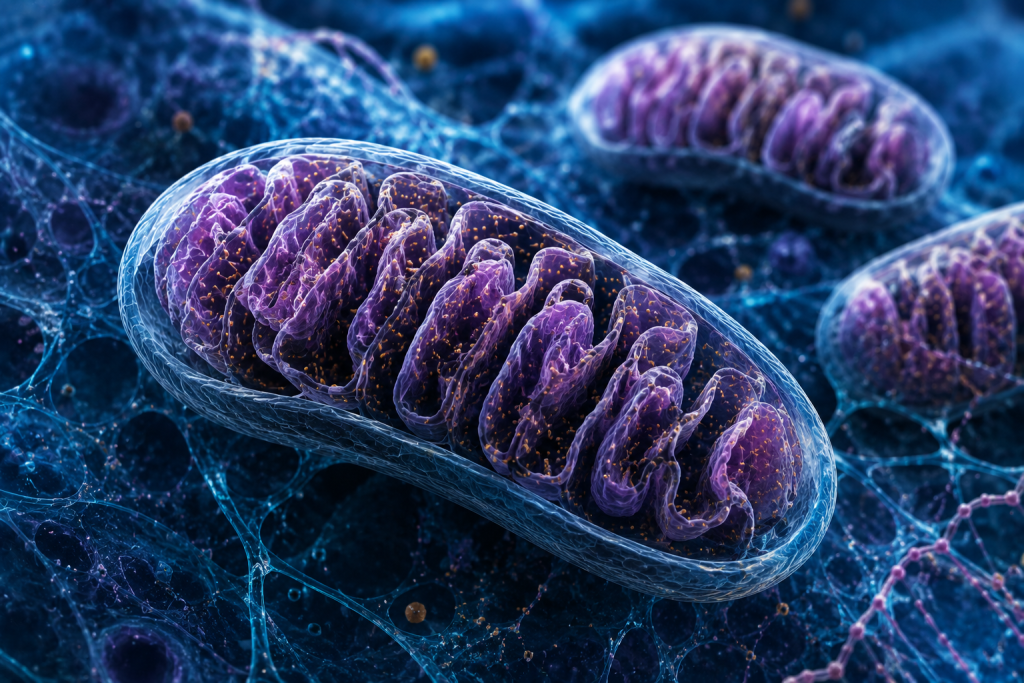

First: What Are Mitochondria?
Mitochondria are commonly described as the powerhouses of the cell.
That’s accurate, but incomplete.
They’re responsible for producing much of the ATP our cells use for energy, but mitochondria also participate in processes involving metabolism, oxidative stress, cell death, calcium signaling and adaptation to environmental stress.
And unlike most structures inside our cells, mitochondria contain some of their own DNA.
Scientists once viewed mitochondrial DNA primarily as instructions for proteins needed to operate the mitochondria themselves.
Research over the last several decades has complicated that picture.
Scientists have discovered tiny biologically active peptides encoded within mitochondrial DNA, collectively known as mitochondrial-derived peptides, or MDPs.
These include Humanin, several small Humanin-like peptides—and MOTS-c.
In other words, mitochondria aren’t merely responding to instructions from the rest of the cell.
They may also be sending instructions back.
What Exactly Is MOTS-c?
MOTS-c stands for:
Mitochondrial Open Reading Frame of the 12S rRNA-c.
Thankfully, MOTS-c is considerably easier to say.
It is a short peptide containing 16 amino acids.
Researchers first described MOTS-c in 2015 after identifying a previously unrecognized short open reading frame within the mitochondrial 12S ribosomal RNA gene.
The discovery challenged the traditional idea of what mitochondrial DNA was capable of encoding.
The researchers also detected naturally occurring MOTS-c in multiple tissues and in human circulation.
But identifying the peptide was only the beginning.
Researchers then needed to determine what it actually did.
And metabolism quickly became one of the major clues.
MOTS-c and Metabolism
The original MOTS-c research found that the peptide affected cellular metabolic pathways.
One particularly important pathway involved AMP-activated protein kinase, usually abbreviated AMPK.
AMPK acts somewhat like a cellular energy sensor.
When cellular energy becomes limited, AMPK helps shift metabolism toward processes that generate energy while reducing some energy-consuming activities.
Exercise, calorie restriction and other metabolic stresses can influence AMPK signaling.
Researchers found that MOTS-c affected the folate and purine pathways in a way that ultimately resulted in AMPK activation.
This provided an important clue about why MOTS-c might influence metabolism.
It also led researchers toward another major area of investigation:
glucose regulation and insulin sensitivity.
What Happened in the Original Mouse Studies?
Some of the claims surrounding MOTS-c today trace directly back to its 2015 discovery paper.
Researchers tested MOTS-c in mice exposed to a high-fat diet.
The results were striking.
MOTS-c treatment protected the animals against diet-induced obesity and insulin resistance under the experimental conditions.
Researchers also reported protection against age-dependent insulin resistance in older mice.
Those findings helped turn MOTS-c into an intriguing candidate for metabolic research.
But there’s an enormous distinction to keep in mind:
These were mouse experiments.
They don’t establish that administering MOTS-c causes weight loss or treats insulin resistance in humans.
The research demonstrates an interesting biological effect worthy of further investigation.
That’s different from demonstrating a therapy.
Why Skeletal Muscle Matters
One of the most interesting findings from the early MOTS-c research involved skeletal muscle.
The investigators identified skeletal muscle as an important target of MOTS-c’s metabolic effects.
That makes biological sense.
Skeletal muscle isn’t merely responsible for movement.
It’s one of the body’s largest metabolically active tissues and plays an enormous role in glucose utilization and overall metabolic health.
During physical activity, muscle cells experience rapidly changing energy demands.
Mitochondria must respond.
Fuel utilization changes.
Cellular stress-response pathways activate.
And signals are produced that help the body adapt to exercise.
Researchers eventually discovered that MOTS-c appears to participate in that response.
Your Body Produces MOTS-c During Exercise
This is probably one of the coolest findings in the MOTS-c story.
Researchers published a study in Nature Communications examining MOTS-c and exercise.
Healthy young men performed stationary cycling while researchers collected blood and skeletal-muscle samples.
After exercise, MOTS-c levels in skeletal muscle increased dramatically relative to baseline.
Circulating MOTS-c also increased during and after exercise before returning toward baseline during recovery.
That tells us something important.
MOTS-c isn’t merely an experimental molecule scientists created and injected into animals.
It’s an endogenous peptide involved in normal human biology, and its expression responds to physical activity.
What that increase accomplishes in humans remains an active research question.
But the exercise response gives researchers a compelling reason to keep looking.
Is MOTS-c an “Exercise Mimetic”?
You’ll occasionally see MOTS-c described online as an exercise mimetic or even “exercise in a bottle.”
That’s taking the research much too far.
There is an interesting reason the comparison arose.
MOTS-c affects metabolic pathways also influenced by exercise, including AMPK signaling.
Exercise increases endogenous MOTS-c.
And experimental MOTS-c administration improved physical performance in mice.
But exercise produces an enormous collection of physiological adaptations across the cardiovascular system, muscles, bones, nervous system, metabolism and brain.
No evidence demonstrates that MOTS-c recreates all of those effects.
So while MOTS-c may participate in exercise-related metabolic signaling, calling it a replacement for exercise isn’t supported by current evidence.
MOTS-c and Physical Performance
The exercise research went beyond measuring MOTS-c levels.
Researchers administered MOTS-c to young, middle-aged and old mice.
They reported improvements in physical performance across age groups.
Perhaps most interestingly, treatment initiated late in life improved physical capacity in older mice and was associated with measures researchers interpreted as improved healthspan.
That finding attracted obvious attention from the longevity community.
If a mitochondrial peptide influences metabolism and helps older animals maintain physical capacity, could it somehow influence aging itself?
That’s where things get much more complicated.
MOTS-c and Aging
Mitochondrial dysfunction is closely associated with aging.
As organisms age, changes occur in mitochondrial function, energy metabolism, cellular stress responses and communication between mitochondria and the rest of the cell.
MOTS-c appears to sit at the intersection of several of those systems.
Research in healthy men has also found age-related differences in endogenous MOTS-c.
One study comparing young, middle-aged and older men found that circulating MOTS-c declined with age, while skeletal-muscle MOTS-c was actually higher in the middle-aged and older groups.
In older men, muscle MOTS-c was also associated with measures of muscle quality.
That tells us the relationship isn’t as simple as:
young = lots of MOTS-c
old = not enough MOTS-c.
Different tissues may regulate the peptide differently as we age.
And that complexity is exactly what we’d expect from a molecule involved in metabolic adaptation.
A Mitochondrial Message to the Nucleus
MOTS-c becomes even stranger here.
Although MOTS-c is encoded by mitochondrial DNA, research suggests that under metabolic stress it can move into the cell nucleus.
Once there, it can influence nuclear gene expression.
Research has associated this nuclear activity with genes involved in cellular stress adaptation, metabolism and antioxidant responses.
Think about what that means biologically.
The mitochondria detect changing conditions.
A peptide encoded by mitochondrial DNA participates in signaling.
That peptide can then influence activity involving genes housed within the nucleus.
This type of mitochondria-to-nucleus communication is known as retrograde signaling.
MOTS-c provides a fascinating example of how mitochondria may actively communicate their metabolic condition to the rest of the cell.
What About Weight Loss?
This is where we need to separate compelling animal research from human evidence.
Yes, the original MOTS-c experiments found protection against diet-induced obesity in mice.
That does not establish MOTS-c as a human weight-loss treatment.
We don’t currently have the kind of large randomized human trials needed to determine whether exogenous MOTS-c produces clinically meaningful weight loss, what its long-term effects would be, or whether benefits would outweigh potential risks.
The metabolic mechanisms are worth investigating.
The mouse results are worth investigating.
Neither makes MOTS-c an established obesity therapy.
What About Insulin Sensitivity?
The evidence here follows a similar pattern.
Experimental research strongly connects MOTS-c with glucose metabolism and insulin sensitivity.
The original mouse study found that MOTS-c improved insulin sensitivity and protected against insulin resistance under particular experimental conditions.
Researchers have subsequently continued investigating its relationship with metabolic disease.
But mechanistic and animal evidence shouldn’t be confused with proof that administering synthetic MOTS-c treats diabetes in people.
That would require controlled clinical trials specifically designed to answer that question.
Does MOTS-c Increase Energy?
Not in the simple way the phrase is usually used online.
Because MOTS-c is mitochondrial and influences energy metabolism, it’s easy for marketing language to turn that into:
“MOTS-c gives you energy.”
That’s not what the research demonstrates.
MOTS-c appears to participate in cellular energy regulation and adaptation to metabolic stress.
That’s a much more interesting—and much more scientifically accurate—description.
Energy metabolism at the cellular level isn’t the same thing as feeling energized after drinking a cup of coffee.
Could MOTS-c Extend Lifespan?
We don’t know.
And this is another area where longevity marketing can outrun the science.
Animal studies showing improved physical capacity or metabolic health in older animals are valuable.
But healthspan and lifespan aren’t identical.
Healthspan refers broadly to the portion of life spent in relatively good health and function.
Lifespan simply refers to how long an organism lives.
The 2021 mouse research provided evidence that MOTS-c could improve late-life physical capacity and aspects of healthspan.
It did not establish that MOTS-c extends human lifespan.
No one currently knows whether it does.
The Human Evidence Is Still Limited
This is probably the most important part of the MOTS-c story.
We do have human MOTS-c research.
Researchers have measured naturally occurring MOTS-c in humans.
They’ve examined how its levels change with age.
They’ve demonstrated that exercise influences endogenous MOTS-c.
And researchers continue studying associations between mitochondrial-derived peptides and metabolic health.
What we don’t yet have is an equivalent body of evidence demonstrating that administering synthetic MOTS-c to humans produces the therapeutic outcomes frequently advertised online.
Those are two very different categories of evidence.
Studying the MOTS-c your body naturally produces is not the same thing as proving the safety and effectiveness of exogenous MOTS-c treatment.
Why MOTS-c Is Still So Interesting
MOTS-c doesn’t need exaggerated claims to be fascinating.
It’s a 16-amino-acid peptide encoded within mitochondrial DNA.
It influences cellular metabolism.
It interacts with AMPK signaling.
It appears capable of participating in communication between mitochondria and the nucleus.
Its levels respond to exercise in humans.
And animal research connects it with insulin sensitivity, metabolic health and physical capacity during aging.
That’s already an extraordinary biological story.
The unanswered question is whether researchers can eventually translate those discoveries into safe and meaningful human therapies.
Maybe they can.
Maybe some of the effects will turn out to be much more limited than current enthusiasm suggests.
That’s precisely what further research is supposed to determine.
For now, MOTS-c is best understood not as a proven weight-loss, performance or anti-aging treatment, but as an intriguing example of something scientists are only beginning to appreciate:
Mitochondria don’t just make energy.
They communicate.
And MOTS-c may be one of the messages.
Research & Educational Disclaimer
This article is intended for general research and educational purposes only. It does not provide medical advice or instructions for purchasing, dosing, injecting or otherwise using MOTS-c. Findings from cellular and animal experiments should not be interpreted as evidence that MOTS-c treats obesity, diabetes, metabolic disease, age-related decline or other conditions in humans. Research involving endogenous MOTS-c in humans also should not be interpreted as establishing the safety or effectiveness of administering synthetic MOTS-c.
Research Sources
Original 2015 MOTS-c discovery and metabolic study — Cell Metabolism
MOTS-c, exercise and age-related physical decline — Nature Communications
MOTS-c in healthy aging human skeletal muscle — PubMed
2023 review of MOTS-c, metabolism, stress and aging — PubMed