Every cell in your body needs energy.
Your heart needs it to beat. Your muscles need it to contract. Your brain needs it to process information. And even when you’re sitting completely still, trillions of cells are continuously performing chemical reactions necessary to keep you alive.
Sitting near the center of many of those reactions is a molecule called NAD+.
Over the past several years, NAD+ has exploded into the longevity world. Supplements promising to “boost NAD+” are everywhere. IV clinics advertise NAD+ infusions. Compounds such as NMN and NR have become staples of anti-aging conversations.
But NAD+ wasn’t discovered by the longevity industry.
Scientists have been studying it for more than a century, and its fundamental role in cellular metabolism is firmly established.
What’s much newer is the idea that declining NAD+ availability may contribute to aspects of aging—and that restoring it might potentially influence age-related biology.
That’s where established biochemistry meets a much younger and considerably less certain field of longevity research.
What Exactly Is NAD+?
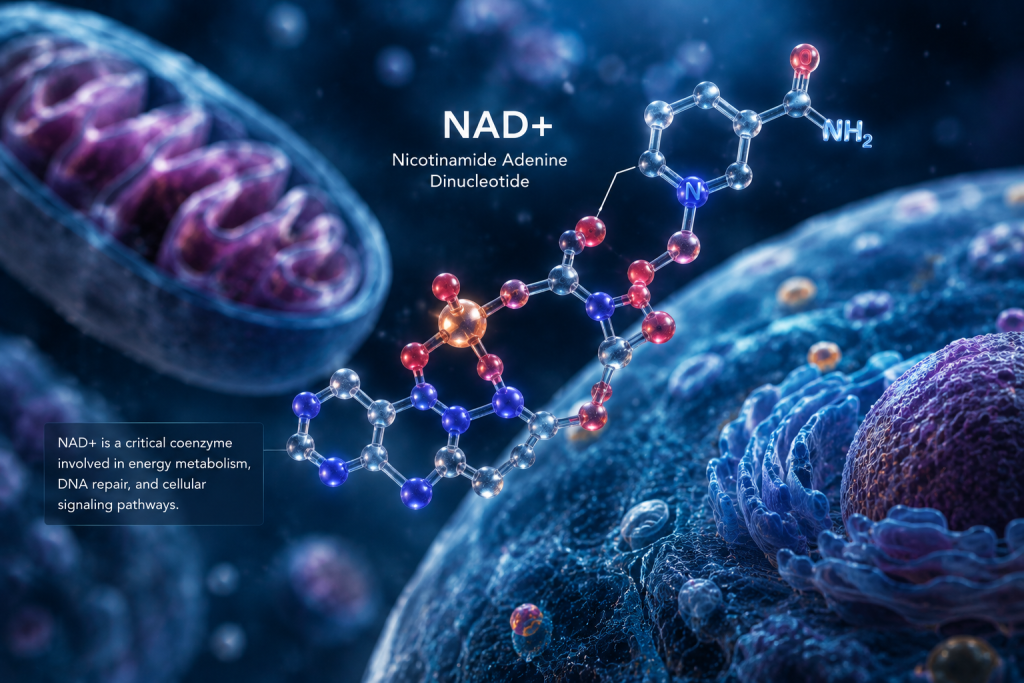
NAD+ stands for nicotinamide adenine dinucleotide.
Despite sometimes appearing alongside peptides in longevity clinics and research-product catalogs, NAD+ is not a peptide.
It’s a coenzyme.
Coenzymes are molecules that help enzymes perform chemical reactions.
And NAD+ participates in hundreds of them.
One of its most important jobs involves transferring electrons during metabolic reactions. NAD+ can accept electrons and become its reduced form, NADH.
The two forms continuously cycle:
NAD+ ⇌ NADH
That may look like a tiny chemical detail, but this cycle is fundamental to the way cells extract usable energy from nutrients.
NAD+ and Cellular Energy
When you eat carbohydrates, fats and proteins, your body doesn’t simply “burn” them.
Those nutrients pass through complicated metabolic pathways that gradually extract their stored chemical energy.
NAD+ helps shuttle electrons during those processes.
NADH can then deliver those electrons into the mitochondrial electron transport chain, where they contribute to production of ATP.
ATP is the molecule cells use as an immediate source of energy.
This means NAD+ sits directly between:
the food you consume
and
the energy your cells can actually use.
Without sufficient NAD+ recycling, energy metabolism couldn’t function normally.
That’s one reason NAD+ is so fundamental to life.
But NAD+ Does More Than Produce Energy
For many years, NAD+ was primarily understood as a metabolic coenzyme.
Then researchers discovered something important.
Certain enzymes don’t simply use NAD+ to transfer electrons.
They actually consume NAD+ as part of their activity.
Several families of enzymes do this, including:
sirtuins, PARPs and CD38.
These enzymes participate in processes involving DNA repair, cellular stress responses, gene regulation, inflammation, metabolism and other aspects of cellular function.
This discovery dramatically expanded scientists’ understanding of NAD+.
Suddenly NAD+ wasn’t merely connected with energy production.
It was also connected with systems involved in how cells respond to damage and stress.
And that’s where aging research became particularly interested.
NAD+ and DNA Repair
DNA is constantly being damaged.
That sounds alarming, but it’s normal.
Everyday metabolism, oxidative stress, environmental exposures and ordinary cellular processes can damage DNA.
Cells therefore maintain extensive repair systems.
One family of enzymes involved in this process is called poly(ADP-ribose) polymerases, or PARPs.
When certain types of DNA damage occur, PARP enzymes become activated and use NAD+ while participating in the repair response.
That’s generally beneficial.
But extensive or persistent DNA damage can cause substantial PARP activation—and therefore increased NAD+ consumption.
Researchers have proposed that this relationship between DNA damage and NAD+ depletion may become increasingly important during aging.
Meet the Sirtuins
If you’ve spent any time reading about longevity, you’ve probably encountered the word sirtuin.
Sirtuins are a family of enzymes involved in regulating numerous cellular processes.
In mammals, there are seven:
SIRT1 through SIRT7.
Different sirtuins operate in different parts of the cell and participate in processes involving metabolism, mitochondrial function, DNA repair and cellular stress responses.
Importantly, sirtuins are NAD+-dependent enzymes.
They require NAD+ to perform their enzymatic activity.
This relationship helped generate enormous interest in whether age-related changes in NAD+ might alter sirtuin activity and therefore influence aspects of aging biology.
But there’s an important distinction.
The fact that sirtuins require NAD+ does not mean:
more NAD+ = more longevity.
Biological systems are considerably more complicated than that.
Does NAD+ Decline With Age?
This is one of the central claims in the longevity conversation.
And there is evidence supporting age-related changes in NAD+ metabolism.
Studies in animal models have demonstrated declining NAD+ concentrations in multiple tissues during aging, and human research has also reported age-associated differences in NAD+ and related metabolites.
A major review in Nature Metabolism described declining NAD+ as a feature observed across multiple tissues and discussed mechanisms that may contribute, including altered biosynthesis and increased consumption.
However, the decline isn’t necessarily identical in every tissue or every person.
Human NAD+ biology is affected by numerous factors, including metabolic health, inflammation, physical activity, diet and disease.
So saying “NAD+ declines with age” is useful as a general research concept.
It shouldn’t be interpreted as though everyone reaches a particular birthday and suddenly becomes NAD+ deficient.
Why Might NAD+ Decline?
There probably isn’t one single cause.
Researchers have proposed several.
One involves increased consumption.
As cellular damage and inflammation accumulate, NAD+-consuming enzymes may become more active.
CD38 has attracted particular attention.
CD38 is an enzyme involved in immune signaling that also consumes NAD+.
Animal research suggests that CD38 activity increases during aging and may contribute significantly to age-related NAD+ decline.
Meanwhile, the body’s ability to recycle and synthesize NAD+ may also change.
The result is a complicated balance between:
how much NAD+ the body produces,
how efficiently it recycles it,
and
how quickly enzymes consume it.
Where Does NMN Come Into This?
This is where the supplement world enters the story.
Your body can manufacture NAD+ using several pathways.
One important pathway recycles forms of vitamin B3.
Within this process is a molecule called nicotinamide mononucleotide, better known as NMN.
NMN is a direct precursor used by cells to produce NAD+.
That relationship led researchers to ask a logical question:
If NAD+ availability decreases during aging, could supplying more of its precursor help restore it?
Animal experiments produced encouraging results in several areas of metabolism and aging biology.
That sparked enormous interest in NMN.
But animal success doesn’t automatically translate into human anti-aging therapy.
And What Is NR?
Another NAD+ precursor is nicotinamide riboside, or NR.
Like NMN, NR can enter pathways that ultimately produce NAD+.
Human clinical studies have shown that oral NR can increase NAD+-related metabolites in blood.
Human NMN studies have likewise demonstrated effects on NAD+ metabolism.
So there’s good evidence that certain precursors can influence the NAD+ system.
The much harder question is:
Does raising NAD+ produce meaningful health benefits?
That’s still being investigated.
Increasing a biomarker is not automatically the same thing as improving someone’s health.
What About NAD+ IVs?
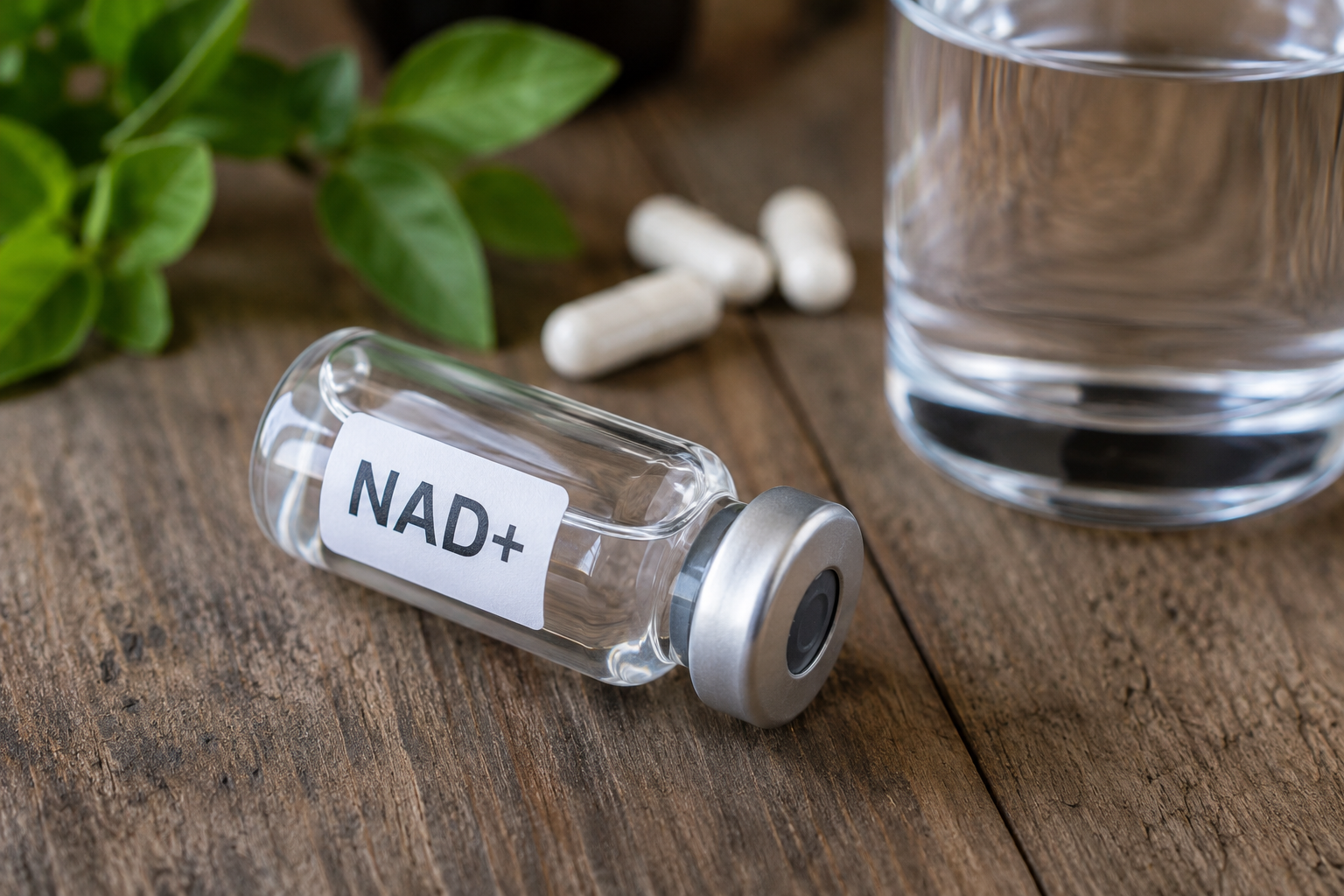
NAD+ itself is also marketed through intravenous infusions.
The logic sounds straightforward:
Why take a precursor when you can administer NAD+ directly?
Biologically, however, things aren’t quite that simple.
Researchers continue investigating how extracellular NAD+ is metabolized and how its components are transported into cells.
NAD+ metabolism involves multiple enzymes, transport mechanisms and precursor pathways.
More importantly, there is not currently robust clinical evidence demonstrating that NAD+ IV therapy reverses aging, restores mitochondria, detoxifies the body or produces the broad range of benefits sometimes advertised by commercial clinics.
That doesn’t mean NAD+ biology isn’t legitimate.
It means marketing claims and scientific evidence need to be evaluated separately.
NAD+ and Mitochondria
This is where our NAD+ discussion connects nicely with MOTS-c.
Mitochondria depend heavily on NAD+/NADH metabolism.
During nutrient metabolism, NADH delivers electrons that contribute to mitochondrial ATP production.
NAD+-dependent enzymes also participate in regulating mitochondrial function.
Researchers therefore study NAD+ in relation to mitochondrial health, metabolic adaptation and cellular aging.
But NAD+ and MOTS-c are very different molecules.
MOTS-c is a mitochondrial-derived peptide encoded within mitochondrial DNA.
NAD+ is a coenzyme used throughout cellular metabolism.
Both intersect with mitochondrial biology.
They simply approach it from very different directions.
NAD+ and Metabolic Health
Because NAD+ is so deeply involved in energy metabolism, researchers have naturally investigated it in relation to metabolic disease.
Animal experiments involving NAD+ precursors have reported effects involving:
insulin sensitivity,
glucose metabolism,
mitochondrial function,
fat metabolism,
and responses to high-fat diets.
Human results have been more mixed.
For example, a randomized clinical trial involving NMN in women with prediabetes found improved skeletal-muscle insulin sensitivity after supplementation, although other metabolic outcomes did not necessarily change in parallel.
That’s exactly why human trials matter.
Biology rarely produces a simple “everything improved” result.
What About Exercise?
Exercise is one of the most reliable interventions we currently have for improving metabolic and cardiovascular health.
It also interacts with NAD+ biology.
Exercise changes cellular energy demand, mitochondrial activity and metabolic signaling.
Research has investigated how physical activity affects NAD+ metabolism and NAD+-dependent enzymes in skeletal muscle.
This creates an interesting overlap between several areas we’ve discussed:
exercise → mitochondrial stress → metabolic adaptation → NAD+ metabolism → cellular signaling.
And, as we covered in the MOTS-c article, exercise also increases endogenous MOTS-c.
The body isn’t relying on one magical longevity molecule.
It’s coordinating an enormous network of metabolic signals.
Can NAD+ Improve Energy?
This question requires some careful wording.
NAD+ is unquestionably involved in cellular energy production.
That is basic biochemistry.
But that does not mean increasing NAD+ automatically makes a person feel more energetic.
“Cellular energy” and the subjective feeling of having energy are not the same thing.
Fatigue can be influenced by sleep, anemia, hormones, nutrition, infection, medications, stress, cardiovascular health and dozens of other factors.
So while NAD+ is essential for cellular metabolism, claims that an NAD+ product will simply “give you energy” oversimplify the science considerably.
Can NAD+ Slow Aging?
This is the billion-dollar question.
Animal research has provided substantial evidence connecting NAD+ metabolism with multiple hallmarks and mechanisms associated with aging.
Restoring NAD+ availability in experimental animals has produced interesting effects involving metabolism, mitochondrial function and age-related physiology.
But humans aren’t oversized laboratory mice.
We currently do not have evidence demonstrating that raising NAD+ levels extends human lifespan.
Nor do we have evidence establishing NAD+ infusions or precursor supplements as therapies capable of reversing human aging.
The research is promising enough to justify continued investigation.
It isn’t mature enough to justify calling NAD+ a proven anti-aging treatment.
More NAD+ Isn’t Necessarily Always Better
This is an important point that often disappears from commercial discussions.
NAD+ is involved in fundamental biological processes.
That doesn’t mean endlessly increasing it must be beneficial.
Cells carefully regulate metabolic pathways for a reason.
NAD+ is also used by enzymes involved in inflammation, immune activity and cellular stress responses.
And researchers are still working to understand how manipulating NAD+ metabolism might affect different tissues and disease states over long periods.
Longevity biology rarely follows the rule:
if some is necessary, more must be better.
What Human Research Still Needs to Answer
We know considerably more about NAD+ than we did twenty years ago.
But some of the questions consumers care about most remain unresolved.
Can long-term NAD+ restoration meaningfully improve healthspan?
Which people might actually benefit?
Does age matter?
Does baseline metabolic health matter?
Are NMN and NR clinically equivalent?
Does directly administering NAD+ offer advantages over precursors?
What are the effects of maintaining elevated NAD+ metabolism for years?
And most importantly:
Do changes in NAD+ translate into fewer diseases, better function or longer life?
Those are much harder questions than simply demonstrating that a supplement increases a blood biomarker.
Why NAD+ Research Matters
NAD+ deserves attention without any anti-aging hype.
It’s one of the most fundamental molecules in cellular biology.
It helps cells convert nutrients into usable energy.
It’s consumed by enzymes involved in DNA repair and cellular regulation.
It’s intimately connected with mitochondrial function.
Its metabolism changes with age.
And researchers have demonstrated that manipulating the NAD+ system can produce substantial biological effects in experimental models.
That’s already fascinating.
Whether those discoveries eventually lead to therapies that meaningfully alter human aging remains unknown.
And that’s precisely why NAD+ belongs in the research conversation.
The goal isn’t to turn every molecule associated with aging into the next miracle treatment.
It’s to understand the biological systems that change as we age—and determine which of those changes actually matter.
NAD+ has given researchers one very important piece of that puzzle.
There are still plenty of pieces missing.
Research & Educational Disclaimer
This article is intended for general research and educational purposes only. It does not provide medical advice or instructions for purchasing, preparing, dosing, injecting, infusing or otherwise using NAD+, NMN, NR or related compounds. Research involving NAD+ metabolism should not be interpreted as evidence that NAD+ products prevent, treat or reverse aging or disease. Individual products and routes of administration may also differ substantially in their evidence, safety and regulatory status.