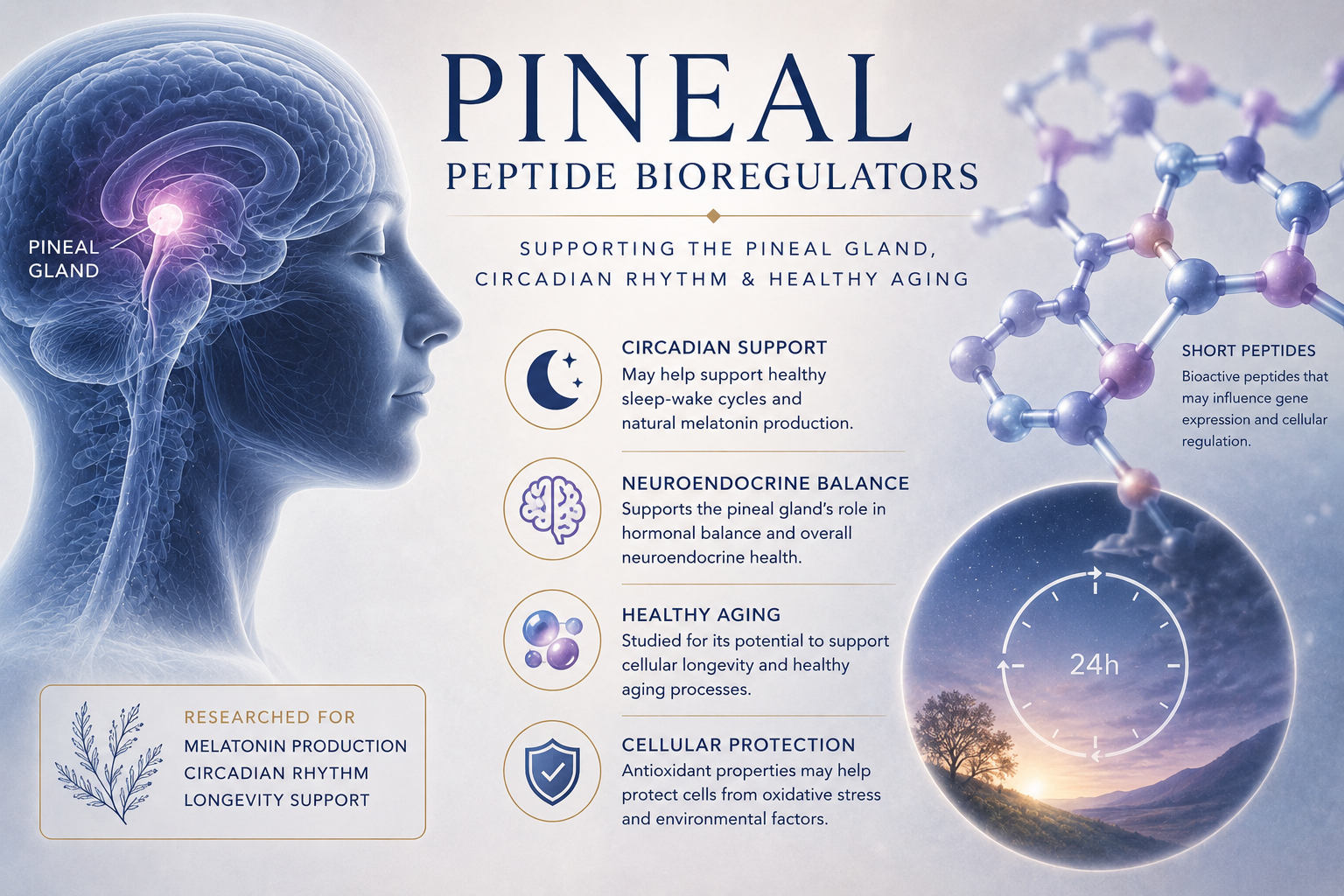
The pineal gland is tiny.
Located deep within the brain, this small endocrine gland weighs only a fraction of a gram, yet it plays an outsized role in one of the body’s most fundamental biological systems: circadian rhythm.
Most people know the pineal gland because it produces melatonin, the hormone closely associated with the body’s sleep-wake cycle.
But researchers studying aging have been interested in the pineal gland for another reason.
Its function changes as we age.
That relationship between the pineal gland, melatonin, circadian biology and aging became one of the major areas investigated in the peptide-bioregulator research associated with Russian gerontologist Vladimir Khavinson and his colleagues.
From that work emerged an entire category of compounds known as pineal peptide bioregulators.
And they’re a useful example of just how different bioregulator research is from the peptide compounds most people encounter online.
Why Study the Pineal Gland?
The pineal gland’s best-established function is the production of melatonin.
Melatonin secretion follows a strong circadian pattern. Levels normally rise in darkness and fall with exposure to light, helping communicate information about the environmental day-night cycle throughout the body.
That signal interacts with systems involved in sleep timing, endocrine function and other physiological rhythms.
But melatonin production and circadian organization can change with age.
Researchers have therefore spent decades investigating whether deterioration in circadian signaling is simply a consequence of aging—or whether disruption of these biological rhythms might itself contribute to aspects of age-related decline.
This is the scientific environment in which pineal peptide research developed.

Where Do Peptide Bioregulators Enter the Picture?
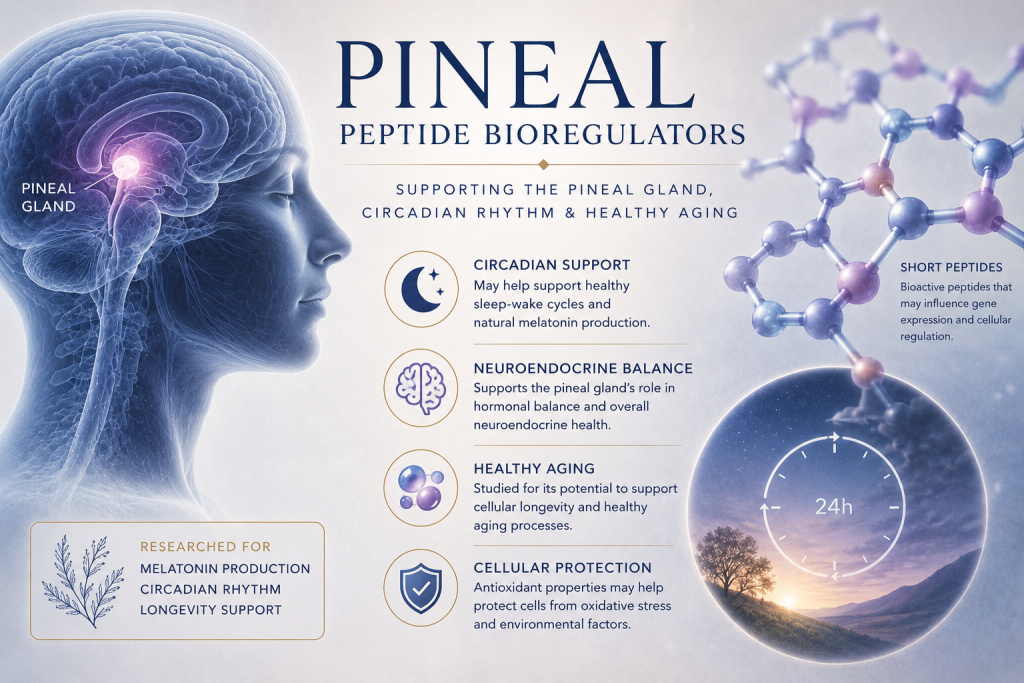
Peptide bioregulators are generally very short chains of amino acids.
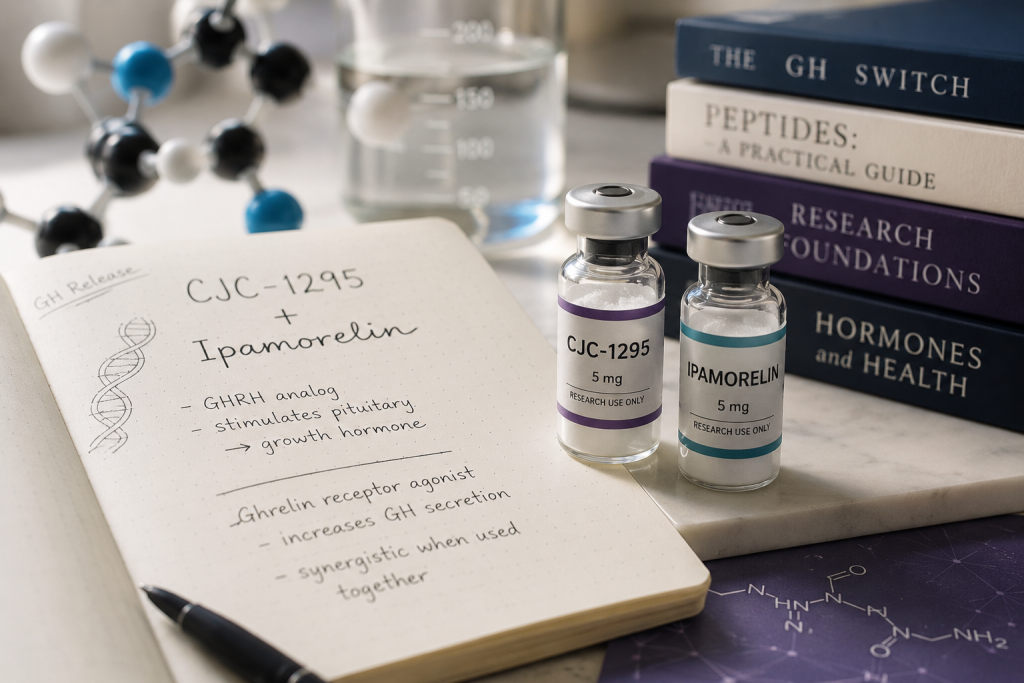
Unlike CJC-1295 or ipamorelin, the bioregulator research program wasn’t primarily built around activating a particular cell-surface receptor.
Instead, Khavinson and colleagues proposed that certain short peptides may participate in the regulation of cellular activity, including processes associated with gene expression and protein synthesis.
That led researchers to investigate peptide preparations originating from different tissues.
Pineal tissue became especially important because of its relationship with aging and neuroendocrine regulation.
Early work involved peptide preparations derived from the pineal gland.
Later research investigated specific short synthetic peptide sequences intended to reproduce some of the biological activity researchers attributed to those preparations.
This is where names such as Epithalamin and Epitalon begin appearing in the literature.
Pineal Extracts and Synthetic Peptides Aren’t the Same Thing
This distinction is important when reading older studies.
A tissue-derived peptide preparation may contain a mixture of peptides.
A synthetic peptide, on the other hand, has a defined amino-acid sequence.
Those aren’t automatically interchangeable.
The bioregulator field evolved from studying peptide fractions derived from organs toward identifying very short sequences that researchers believed contributed to their biological activity.
Consequently, you’ll encounter research involving several related—but not identical—pineal preparations.
When someone says simply that “pineal peptides were studied,” the next question should always be:
Which peptide or preparation?
That matters enormously when evaluating the evidence.
The Pineal Gland and Melatonin
Because the pineal gland produces melatonin, researchers naturally investigated whether pineal peptide preparations could influence melatonin production or circadian function.
This became particularly interesting in older populations, where nighttime melatonin secretion can be altered.
Some of the Khavinson-associated clinical literature reports changes in melatonin-related measures following administration of pineal peptide preparations.
These findings contributed to the hypothesis that peptide regulation might influence aspects of pineal function during aging.
But there’s an important limitation.
Evidence that a peptide influences melatonin or another biological marker doesn’t automatically establish that it treats insomnia, reverses aging or extends human lifespan.
Those are much larger clinical claims.
The distinction between a biomarker and a meaningful health outcome matters just as much here as it does in the rest of peptide research.
Then There’s Epitalon
Epitalon is probably the best-known compound to emerge from this area of research.
It’s an extremely short synthetic peptide composed of just four amino acids:
Alanine – Glutamate – Aspartate – Glycine
That makes Epitalon a tetrapeptide.
Its small size is striking compared with many better-known peptide compounds.
Epitalon has been investigated in experimental aging research involving several biological processes, which is why it eventually developed a reputation as an “anti-aging peptide.”
But that description skips a lot of nuance.
Epitalon makes more sense when understood as part of a much larger research program examining pineal biology, short peptides, cellular regulation and aging.
It wasn’t simply created as a generic longevity supplement.
What About Telomeres?
This is where Epitalon becomes especially famous—and where claims frequently get ahead of the evidence.
Telomeres are repetitive DNA sequences located at the ends of chromosomes.
They help protect chromosome ends during cell division, but telomeres generally become shorter as cells repeatedly divide.
That relationship has made telomeres one of the most recognizable areas of aging research.
Researchers associated with the peptide-bioregulator field investigated whether Epitalon could influence telomerase, an enzyme capable of extending telomeric DNA.
Experimental studies reported telomerase activation and telomere elongation in certain human cell cultures exposed to Epitalon.
That’s fascinating.
But notice the words cell cultures.
A compound affecting telomerase activity in cultured cells does not automatically mean taking that compound causes a person to live longer.
Those are profoundly different scientific questions.
Does Pineal Peptide Research Show Increased Lifespan?
There is experimental longevity research associated with this field.
Animal studies from Khavinson and colleagues have investigated pineal peptides and Epitalon in relation to lifespan and age-related biological changes.
Some reported increased lifespan or changes in age-related pathology in experimental animals.
That’s one reason these compounds became so prominent within longevity communities.
But animal longevity research is notoriously difficult to translate into humans.
A mouse living longer after an experimental intervention is an important scientific observation.
It isn’t proof that the same intervention extends human lifespan.
Human longevity trials would require enormous populations and extraordinarily long follow-up periods.
Those data simply don’t exist at the level necessary to call pineal bioregulators proven human life-extension treatments.
Circadian Biology May Be the More Interesting Story
The obsession with “living longer” can actually distract from one of the most scientifically interesting aspects of pineal research.
Our bodies operate according to biological clocks.
Sleep, hormone secretion, body temperature, metabolism and numerous other physiological processes fluctuate according to circadian rhythms.
Aging is associated with changes in many of those rhythms.
The pineal gland sits directly within this conversation because of its role in melatonin secretion.
That makes the broader question fascinating:
Could age-related changes in regulatory signaling contribute to deterioration of biological rhythms?
And, if so:
Could short peptides influence some of those regulatory systems?
Those are legitimate research questions even if nobody ever proves that a pineal peptide makes humans live to 120.
Natural Bioregulators vs. Synthetic Bioregulators
This is another distinction worth understanding.
Some commercially available bioregulator products contain peptide complexes derived from animal tissues rather than isolated synthetic peptides.
For example, the pineal bioregulator currently listed by Spring 2 Wellness is described as an animal-tissue-derived peptide complex, while Epitalon is separately sold as a defined peptide product.
Those shouldn’t automatically be treated as identical substances.
One contains a tissue-derived peptide complex.
The other centers on a particular short peptide.
Their relationship comes from the history and theory of peptide bioregulation—not from them being chemically identical.
What About Sleep?
This is probably the most obvious question.
If pineal peptides interact with pineal function and the pineal gland produces melatonin, does that mean pineal bioregulators are sleep aids?
We don’t have enough evidence to make that leap.
There is biological and experimental research connecting pineal peptides with melatonin and circadian regulation.
That’s interesting.
But established treatment claims require controlled clinical studies demonstrating meaningful improvements in outcomes such as sleep onset, sleep duration, nighttime awakenings or objectively measured sleep architecture.
A product shouldn’t automatically inherit all of melatonin’s biology simply because its research involves the pineal gland.
That’s exactly the kind of distinction this field requires.
Are Pineal Bioregulators Proven Anti-Aging Treatments?
No.
And that doesn’t mean the research should be dismissed.
This is one of the recurring problems with longevity science.
Something interesting happens in cells.
Then something interesting happens in animals.
Researchers develop a plausible mechanism.
A few human studies produce intriguing observations.
And suddenly the internet jumps five steps ahead and announces:
“Scientists discovered how to reverse aging.”
That’s not how evidence works.
Pineal peptide bioregulators have an unusual and genuinely interesting research history.
They’ve been investigated in relation to aging, circadian biology, melatonin, gene regulation, telomeres and longevity.
But that evidence does not establish them as proven treatments capable of reversing human aging.
Why This Research Still Matters
The pineal-bioregulator story is valuable precisely because it asks a larger question than whether a compound makes someone sleep better or look younger.
It asks whether small regulatory peptides may participate in the molecular systems that maintain normal cellular function over time.
That hypothesis has generated decades of experimental work.
Some findings are compelling.
Some remain preliminary.
Many need independent replication.
And some of the biggest claims associated with these compounds today extend substantially beyond what the evidence can currently support.
That’s exactly why they’re worth studying carefully.
The goal shouldn’t be to decide that every bioregulator is either miraculous or worthless.
The goal should be to understand what researchers actually observed—and where observation ends and speculation begins.
Research & Educational Disclaimer
This article is intended for general research and educational purposes only. It does not provide medical advice or instructions for purchasing, dosing, administering or using pineal peptide bioregulators, Epitalon or related compounds. Products marketed as peptide bioregulators may differ substantially in composition, quality and regulatory status. Experimental findings involving cells or animals should not be interpreted as evidence that a compound prevents, treats or reverses disease or aging in humans.