When pain or inflammation develops, the body doesn’t simply sit back and wait for the problem to disappear.
It produces its own signaling molecules designed to help regulate the response.
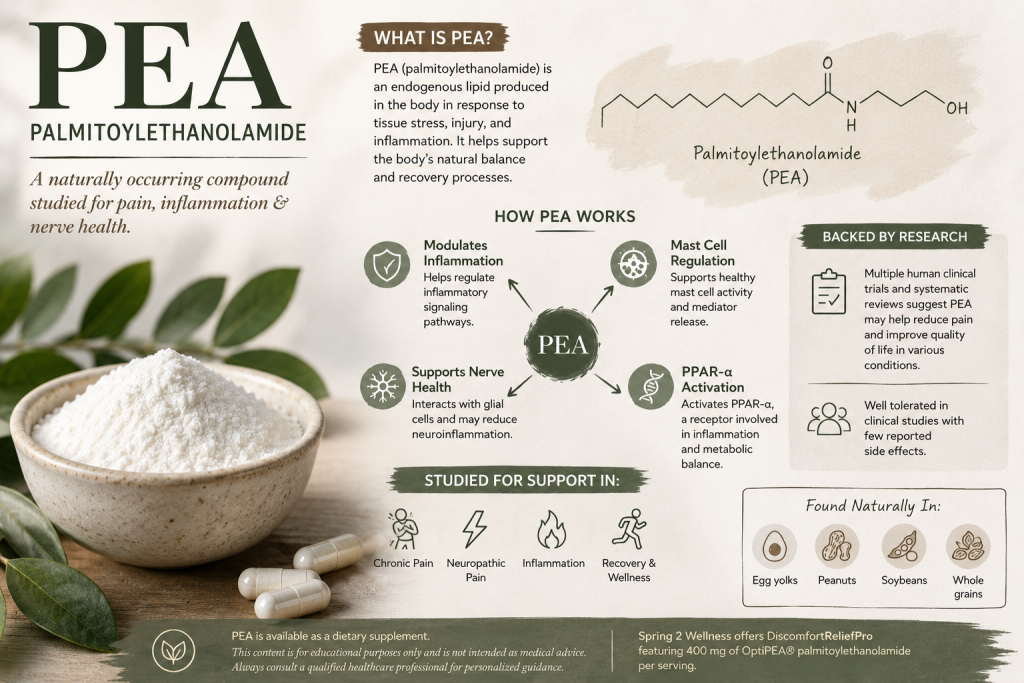
One of those molecules is palmitoylethanolamide, usually shortened to PEA.
PEA isn’t a peptide.
It isn’t a cannabinoid.
And despite being sold today as a dietary supplement, it isn’t a newly discovered compound created by the supplement industry.
PEA is a naturally occurring lipid molecule produced within the human body and found in various foods. Researchers have been studying it for decades because of its apparent involvement in the body’s response to inflammation, tissue stress and pain.
More recently, human clinical trials have begun investigating whether supplemental PEA could be useful for conditions involving chronic and neuropathic pain.
The results are interesting—but, as usual, they’re more nuanced than the marketing surrounding them.
What Is PEA?
Palmitoylethanolamide belongs to a family of naturally occurring lipids called N-acylethanolamines.
The body produces PEA in numerous tissues.
Rather than functioning like a conventional painkiller that simply blocks a particular pain signal, PEA appears to participate in the body’s mechanisms for maintaining cellular homeostasis.
Homeostasis basically means keeping biological systems within a functional balance.
When tissues are injured or exposed to inflammatory stress, concentrations of PEA can change.
Researchers have therefore proposed that PEA functions partly as an endogenous protective response—a molecule the body produces when cells are under stress.
That makes PEA very different from something like ibuprofen or acetaminophen.
The molecule already exists inside us.
The research question is whether increasing its availability can meaningfully influence pain or inflammation.
Is PEA a Cannabinoid?
This is one of the most common sources of confusion.
PEA is sometimes described as “endocannabinoid-like.”
But PEA itself isn’t considered a classical endocannabinoid like anandamide.
It doesn’t primarily work by directly activating CB1 and CB2 cannabinoid receptors in the same way compounds associated with cannabis may interact with those receptors.
Instead, PEA appears to influence several biological pathways that overlap or interact with the endocannabinoid system.
One of its most important targets is something completely different:
PPAR-alpha.
What Is PPAR-Alpha?
PPAR-alpha stands for peroxisome proliferator-activated receptor alpha.
It’s a nuclear receptor involved in regulating gene expression.
Rather than sitting on the outside of a cell waiting for a signal, nuclear receptors can influence which genes are turned on or off.
PPAR-alpha participates in several processes involving:
fat metabolism,
cellular energy regulation,
inflammatory signaling,
and immune responses.
Research has identified PPAR-alpha as a major mediator of PEA’s anti-inflammatory activity. In experimental models, PEA’s ability to reduce inflammation was dramatically affected when PPAR-alpha signaling was absent.
That’s one reason researchers don’t describe PEA as simply another cannabinoid compound.
Its biology extends into several different signaling systems.
PEA and Inflammation
Inflammation isn’t inherently bad.
It’s part of the body’s defense and repair system.
If you injure tissue, immune cells release chemical signals that help coordinate the response.
The problem occurs when inflammatory signaling becomes excessive or persists longer than necessary.
That can contribute to chronic pain and tissue sensitivity.
PEA appears to interact with several components of this inflammatory response, including signaling involving PPAR-alpha, inflammatory cytokines, mast cells and glial cells.
And those last two are especially interesting.
PEA and Mast Cells
Most people associate mast cells with allergies.
That’s certainly one of their jobs.
But mast cells are immune cells that participate in a much broader range of inflammatory responses.
When activated, they can release compounds including histamine, cytokines and other inflammatory mediators.
Mast cells are also found near nerve endings.
That means excessive mast-cell activation can potentially contribute to both inflammation and pain sensitivity.
Researchers have studied PEA’s ability to regulate mast-cell activity for decades.
Rather than simply shutting mast cells down—which wouldn’t necessarily be desirable because they perform important immune functions—PEA appears to help modulate their activation.
That distinction is important.
The goal of inflammatory regulation isn’t always to eliminate the immune response.
Sometimes it’s to prevent the response from becoming excessive.
Then There Are Glial Cells
The nervous system contains much more than neurons.
Neurons receive most of the attention because they transmit electrical signals.
But they’re surrounded and supported by cells collectively known as glia.
Glial cells perform essential roles in maintaining and protecting the nervous system.
They also participate in immune and inflammatory responses within nervous tissue.
When glial activation becomes persistent, researchers believe it can contribute to neuroinflammation and chronic pain sensitization.
PEA has been studied for its ability to influence both mast-cell and glial activity, which may help explain why so much of the clinical research surrounding PEA has focused on neuropathic and chronic pain.
What Is Neuropathic Pain?
Not all pain works the same way.
If you cut your finger, pain receptors detect tissue damage and send a warning signal.
That’s useful pain.
Neuropathic pain is different.
It results from damage or dysfunction affecting the nervous system itself.
People may describe it as:
burning,
shooting,
electric,
tingling,
stabbing,
or hypersensitivity to touch.
Because the nervous system itself is involved, neuropathic pain can be notoriously difficult to manage.
This is one area where PEA research has attracted considerable interest.
Does PEA Actually Reduce Pain in Humans?
Unlike many compounds in the wellness world, PEA isn’t supported exclusively by cell cultures and animal studies.
There are human randomized controlled trials.
A 2023 systematic review and meta-analysis examined double-blind randomized controlled trials involving 774 patients with chronic pain.
Across the included studies, PEA was associated with a significant reduction in pain scores compared with control treatments.
Some studies also reported improvements in function and quality of life, and no major adverse effects were attributed to PEA within the included trials.
That’s encouraging.
But it doesn’t mean the research is finished.
What Do Larger Reviews Show?
A newer systematic review published in 2025 examined 47 randomized controlled trials involving PEA across numerous patient populations.
The researchers concluded that the strongest evidence appeared in studies involving pain management and measures of general wellbeing, particularly with certain micronized or otherwise enhanced formulations.
PEA was also generally well tolerated in the studies reviewed.
Another recent meta-analysis evaluated 18 randomized trials involving nearly 1,200 participants.
It reported reductions in pain across nociceptive, neuropathic and nociplastic pain categories, along with improvements in pain-related quality of life measures.
That’s enough research to make PEA genuinely interesting.
But there are still limitations.
The Evidence Isn’t Perfect
Earlier reviews identified some substantial problems with the PEA literature.
Studies have examined different conditions.
Different formulations have been used.
Treatment duration varies.
Some trials have been small.
And study quality hasn’t always been ideal.
One systematic review examining musculoskeletal and neuropathic pain found positive results overall but also identified extremely high heterogeneity among the included studies and signs of possible publication bias.
An earlier meta-analysis similarly concluded that PEA appeared promising while noting weaknesses in trial quality and adverse-event reporting.
That’s an important reminder:
A supplement having clinical research behind it doesn’t automatically mean every research question has been answered.
Why Are Some PEA Products “Micronized”?
There’s another unusual feature of PEA research.
PEA doesn’t dissolve particularly well in water.
That creates challenges for absorption.
Manufacturers have therefore developed formulations in which PEA particles are made much smaller.
These are generally described as:
micronized PEA
or
ultramicronized PEA.
Reducing particle size may improve how the compound behaves during absorption, which is why many clinical studies have used these forms.
However, evidence directly proving that one formulation is clinically superior to another has historically been limited.
A pharmacology and safety review specifically noted the lack of head-to-head clinical comparisons between unmicronized and micronized PEA.
So formulation matters—but claims that one particular form is unquestionably superior deserve scrutiny.
What About OptiPEA®?
PEA is also sold as branded raw-material formulations, including OptiPEA®.
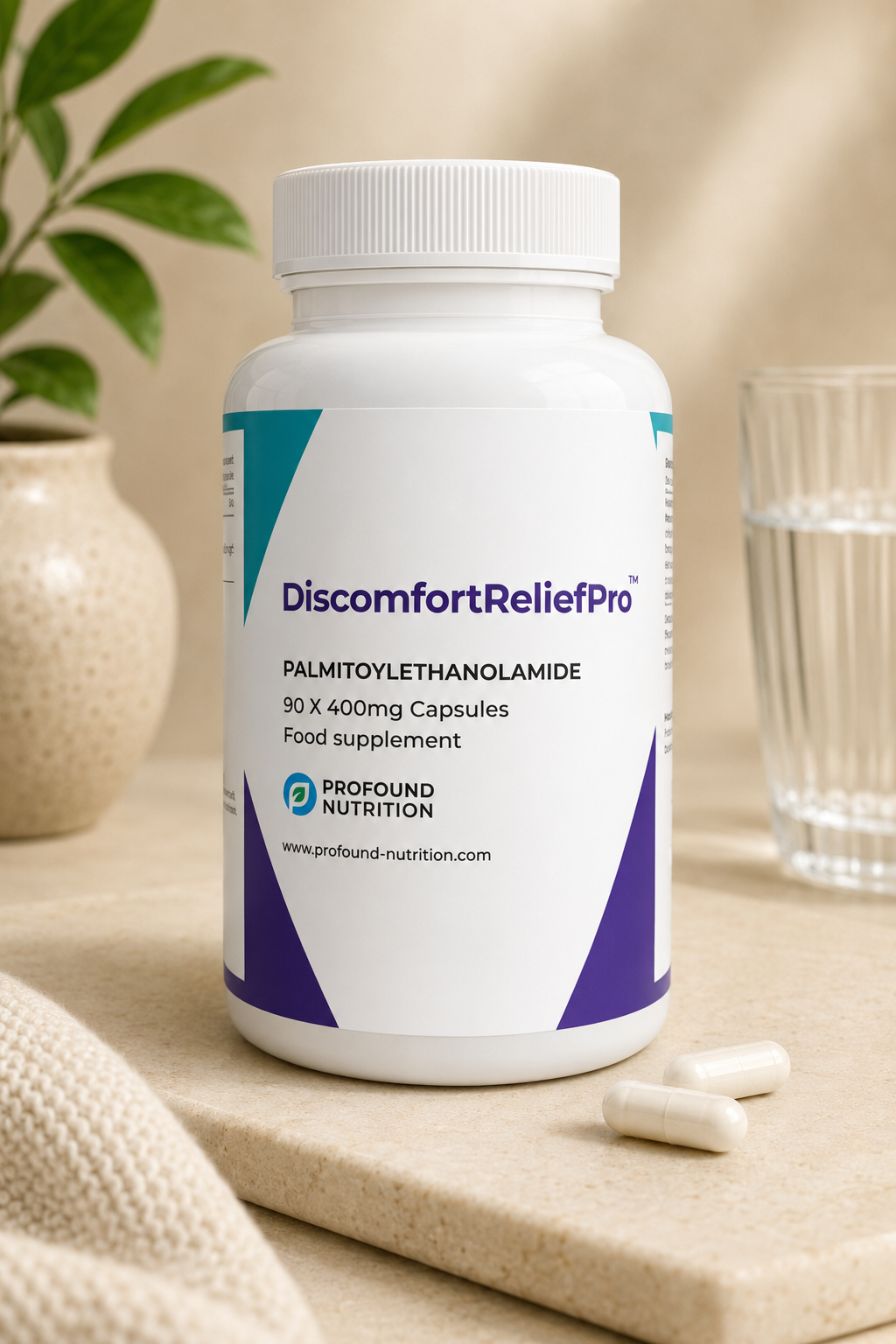
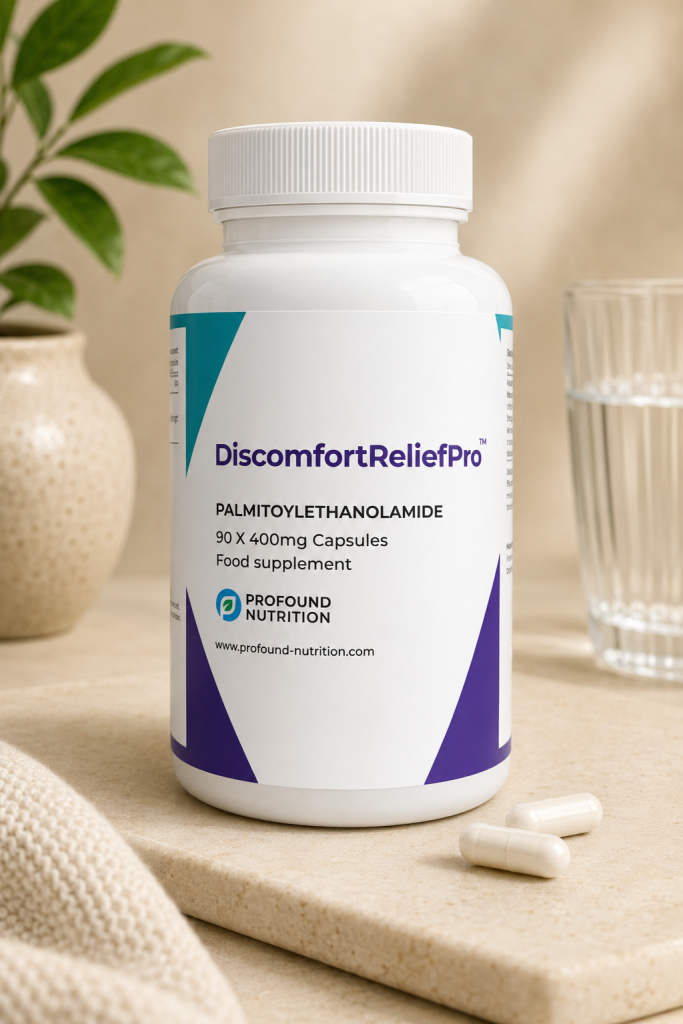
For example, Spring 2 Wellness uses OptiPEA® palmitoylethanolamide in its DiscomfortReliefPro supplement.
That’s relevant because when evaluating research-backed supplements, it’s useful to know exactly which ingredient and formulation a product contains.
But a branded ingredient shouldn’t automatically inherit the results of every PEA study ever conducted.
Clinical evidence should still be evaluated according to the specific formulation, population, dose and outcome actually studied.
That’s true for PEA just as it is for peptides, medications and other supplements.
Is PEA a Painkiller?
Calling PEA a painkiller oversimplifies what researchers think it may be doing.
PEA doesn’t appear to function like an opioid.
It isn’t an NSAID.
And it doesn’t simply numb nerves.
Instead, its effects appear to involve regulation of biological systems associated with inflammation, immune-cell activation and neuronal sensitization.
That may also help explain why clinical studies tend to evaluate PEA over weeks rather than expecting an immediate effect comparable to a conventional acute pain medication.
PEA is better thought of as a bioactive lipid mediator being investigated for pain regulation than as a traditional analgesic.
What About Neuroinflammation?
This is another growing area of research.
Neuroinflammation refers to inflammatory activity involving the nervous system.
Microglia—the resident immune cells of the central nervous system—play an important role in this process.
Short-term activation can be protective.
Persistent activation can become problematic.
Because PEA appears to influence glial cells and inflammatory signaling, researchers have investigated it in experimental models involving neurological injury and neurodegenerative processes.
But this is where we need to draw a strong line between interesting biology and established treatment.
Evidence that PEA influences neuroinflammation does not prove that it treats Alzheimer’s disease, Parkinson’s disease, multiple sclerosis or other neurological disorders.
Those are much larger clinical claims requiring disease-specific human evidence.
Is PEA Safe?
Human research so far suggests PEA is generally well tolerated.
The 2025 systematic review of randomized trials reported good tolerability across the studied populations, while chronic-pain reviews have generally reported relatively few serious safety concerns attributable to PEA.
However, there are limitations.
An earlier safety review noted that the available clinical datasets weren’t large enough to confidently detect uncommon adverse effects, particularly with longer-term exposure.
“Generally well tolerated in clinical trials” is therefore more accurate than saying a compound has no side effects.
PEA Is a Great Example of Why Supplement Research Gets Complicated
PEA sits in an interesting middle ground.
It’s naturally produced by the body.
Its biological mechanisms are plausible and increasingly well characterized.
There is substantial preclinical research.
There are randomized human trials.
And multiple meta-analyses suggest potential benefits for certain types of pain.
That’s considerably stronger evidence than exists for many popular wellness supplements.
At the same time, the research includes heterogeneous study designs, different formulations and variable study quality.
That means two statements can simultaneously be true:
PEA has legitimate scientific evidence behind it.
And:
We still need better clinical research to determine exactly where, how and for whom it works best.
Those ideas aren’t contradictory.
That’s simply what developing evidence looks like.
Why PEA Is Worth Watching
PEA is interesting precisely because it isn’t trying to introduce an entirely foreign mechanism into the body.
It’s part of an endogenous system that already responds to tissue stress and inflammation.
Researchers are essentially asking whether augmenting that system could help the body better regulate inflammatory and pain responses.
Current evidence suggests PEA may have meaningful potential—particularly in chronic and neuropathic pain—but it isn’t a universal treatment for inflammation or pain.
And it certainly isn’t a miracle supplement.
Instead, PEA represents something much more scientifically useful:
a naturally occurring signaling molecule with plausible biological mechanisms, a growing body of human evidence and plenty of unanswered questions still worth studying.
Research & Educational Disclaimer
This article is intended for general research and educational purposes only and does not constitute medical advice. PEA supplements are not substitutes for medical evaluation or treatment of persistent or unexplained pain, inflammation, neurological symptoms or other health conditions. Research findings involving palmitoylethanolamide should be interpreted according to the specific formulation, population and condition studied.