
For years, medications targeting GLP-1 were primarily discussed in the context of diabetes.
Then something much bigger happened.
Researchers discovered that manipulating the body’s nutrient-responsive hormone pathways could produce substantial changes in appetite, body weight, glucose regulation and metabolism.
Semaglutide brought GLP-1 medications into mainstream conversation.
Tirzepatide added a second target—GIP—and produced even greater average weight loss in major clinical trials. In the SURMOUNT-1 trial, the highest tirzepatide dose produced an average weight reduction of 20.9% after 72 weeks.
Now researchers are investigating what happens when a third receptor enters the equation.
That compound is retatrutide.
And the results so far have made it one of the most closely watched drugs in obesity research.
What Is Retatrutide?
Retatrutide—previously known as LY3437943—is an investigational peptide developed by Eli Lilly.
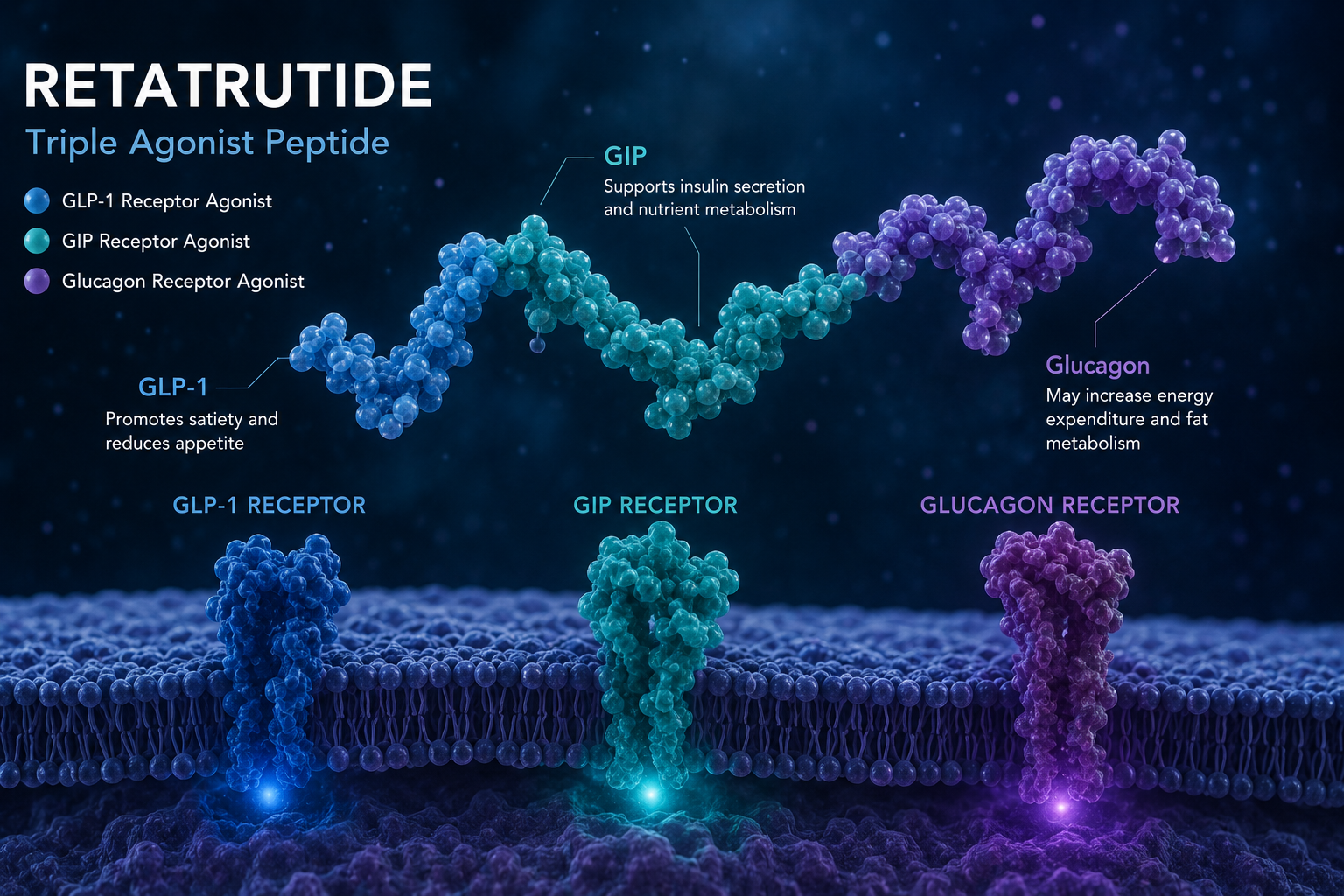
It activates three hormone receptors:
GLP-1 — glucagon-like peptide-1
GIP — glucose-dependent insulinotropic polypeptide
Glucagon
That’s why retatrutide is frequently described as a triple agonist.
Tirzepatide, by comparison, targets GLP-1 and GIP receptors.
Retatrutide adds glucagon-receptor activity.
And that third component is what makes the research particularly interesting.
Why GLP-1?
GLP-1 is released naturally from the intestine after eating.
Among other actions, it participates in glucose-dependent insulin secretion, slows gastric emptying and sends signals involved in satiety.
In other words, GLP-1 helps tell the body:
We’ve eaten.
Activating the GLP-1 receptor pharmacologically can reduce appetite and food intake, which is one reason GLP-1-based medications have become so effective in obesity treatment.
But researchers discovered that GLP-1 wasn’t the only nutrient-responsive hormone worth targeting.
Why Add GIP?
GIP is another incretin hormone released after food intake.
Like GLP-1, it participates in the body’s response to nutrients and influences insulin secretion.
The success of tirzepatide demonstrated just how powerful combining GIP and GLP-1 receptor agonism could potentially be.
In SURMOUNT-1, participants receiving tirzepatide lost substantially more weight than those receiving placebo, with average reductions reaching approximately 21% at the highest studied dose after 72 weeks.
Retatrutide keeps those two targets.
Then it adds something different.
Why Add Glucagon?
Glucagon is often introduced as insulin’s opposite.
When blood glucose falls, glucagon helps signal the liver to release glucose.
But glucagon biology extends beyond blood sugar.
Glucagon signaling also influences energy expenditure, lipid metabolism and nutrient utilization.
That created an interesting possibility.
GLP-1 and GIP activity could influence appetite, satiety and glucose regulation, while carefully controlled glucagon-receptor activation might contribute additional effects on energy balance and metabolism.
Researchers therefore designed retatrutide to combine all three pathways within a single molecule.
Then Came the Phase 2 Trial
This is where retatrutide really attracted attention.
A randomized Phase 2 trial published in The New England Journal of Medicine included 338 adults with obesity or overweight plus a weight-related condition.
Participants received different doses of retatrutide or placebo for 48 weeks.
At the highest studied dose, participants experienced an average body-weight reduction of 24.2% after 48 weeks.
And importantly, the average weight-loss curve had not clearly plateaued when the trial ended.
That was an extraordinary result for an obesity medication.
But it was still Phase 2.
Researchers needed much larger Phase 3 trials.
And Now We Have Phase 3 Results
This part is new.
In May 2026, Lilly announced topline results from the Phase 3 TRIUMPH-1 trial.
Among participants receiving 12 mg retatrutide, average weight loss reached 28.3% after 80 weeks, corresponding to approximately 70 pounds in the study population.
More than 45% of participants receiving that dose lost at least 30% of their starting body weight.
A subgroup with a starting BMI of at least 35 continued treatment through 104 weeks and reached an average reduction of approximately 30.3%.
Those numbers explain why retatrutide is generating so much attention.
They also need some context.
These were company-announced topline Phase 3 results. Detailed peer-reviewed publication and regulatory review remain important steps in evaluating the complete efficacy and safety picture.
Is Retatrutide Better Than Tirzepatide?
It’s tempting to simply compare the percentages.
Tirzepatide:
20.9% average weight loss at the highest dose in SURMOUNT-1 after 72 weeks.
Retatrutide:
24.2% at the highest dose in the Phase 2 trial after 48 weeks.
And according to the 2026 TRIUMPH-1 topline results:
28.3% after 80 weeks at 12 mg.
But those weren’t head-to-head trials.
Different studies can involve different participants, protocols, durations and statistical methods.
So we can’t scientifically take those percentages and declare retatrutide “X percent better than tirzepatide.”
A direct randomized comparison would provide much stronger evidence.
Is Retatrutide Basically a Stronger GLP-1?
Not exactly.
That’s probably the biggest misconception.
Retatrutide isn’t simply a more powerful version of semaglutide.
And it isn’t simply higher-strength tirzepatide.
The entire point of the molecule is its three-receptor pharmacology.
GLP-1, GIP and glucagon signaling overlap in some areas but have different physiological effects.
Researchers are essentially investigating whether coordinating those pathways can influence both sides of energy balance:
how much energy is consumed,
and how the body processes and expends energy.
That makes retatrutide scientifically interesting beyond the amount of weight participants lost.
What Happens to Appetite?
GLP-1-based therapies are well known for affecting appetite and satiety.
Retatrutide retains GLP-1 receptor activity, so reduced energy intake is clearly part of the story.
But researchers are particularly interested in whether glucagon-receptor activation adds metabolic effects beyond appetite suppression alone.
The Phase 2 investigators proposed that glucagon activity could augment effects involving substrate utilization and energy expenditure.
That’s one reason retatrutide is sometimes discussed as potentially doing more than simply making someone less hungry.
Exactly how much each receptor contributes to the overall human effect remains an important research question.
What About Metabolic Health?
Weight wasn’t the only outcome researchers monitored.
Obesity frequently occurs alongside changes in:
blood glucose,
insulin sensitivity,
blood pressure,
blood lipids,
fat distribution,
and liver health.
Retatrutide’s combination of incretin and glucagon signaling makes those metabolic outcomes particularly important.
Lilly’s broader TRIUMPH development program is therefore studying retatrutide across obesity and several related complications, including type 2 diabetes and cardiovascular disease.
Ultimately, the value of an obesity treatment isn’t determined solely by the number on the scale.
Researchers want to know whether it improves the diseases and risks associated with excess adiposity.
What About Side Effects?
Retatrutide isn’t free of adverse effects.
In the Phase 2 trial, the most commonly reported adverse events were gastrointestinal, similar to what researchers have observed with other GLP-1 and GIP/GLP-1 receptor agonists.
These included issues such as nausea, diarrhea, vomiting and constipation.
Gastrointestinal effects were generally dose-related and occurred particularly during dose escalation.
Phase 3 safety data will be especially important because larger trials expose substantially more people to a medication for longer periods.
Powerful efficacy doesn’t eliminate the need to understand risk.
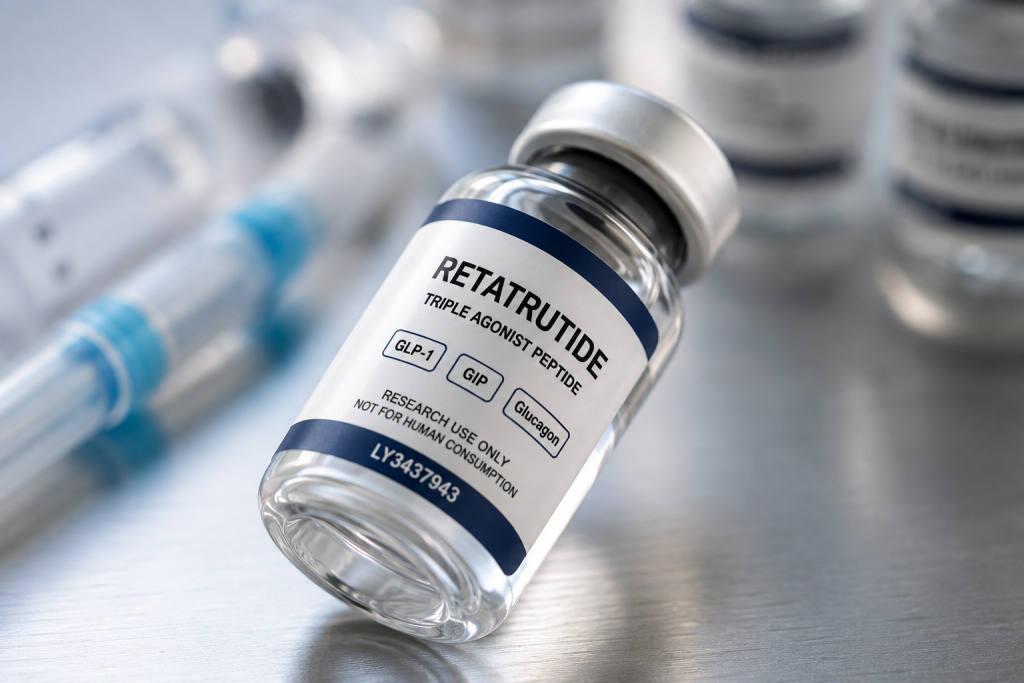
Retatrutide Is NOT Currently an Approved Medication
This needs to be especially clear because retatrutide is already widely discussed online.
As of August 2026, retatrutide has not been approved by the FDA or any other regulatory agency.
Lilly explicitly warns that products being sold online as retatrutide are not Lilly’s investigational drug and may contain incorrect amounts, contaminants—or something else entirely.
That’s fundamentally different from tirzepatide.
Tirzepatide is an approved medication with established manufacturing and regulatory oversight.
Retatrutide remains an investigational compound undergoing clinical development.
Then Why Is “Reta” Already Everywhere?
Because the research results attracted enormous attention before development was complete.
And demand for GLP-1-style weight-management medications is enormous.
That combination created an unofficial market for products claiming to contain retatrutide.
But there’s an important distinction between:
the retatrutide studied in Lilly-sponsored clinical trials
and
a vial sold online with “retatrutide” printed on the label.
Those should never automatically be assumed to be the same thing.
In fact, the unapproved market has become significant enough that regulators and Lilly have taken action against sellers marketing purported retatrutide for human use.
What We Still Don’t Know
Retatrutide has progressed remarkably quickly, but several important questions remain.
What will the complete Phase 3 safety data show?
How durable is the weight loss over several years?
What happens after treatment stops?
How does retatrutide compare directly with tirzepatide?
How much does glucagon-receptor activation contribute to its effects?
What are its long-term cardiovascular outcomes?
Which patients benefit most?
And what uncommon adverse effects might only become apparent when much larger populations receive it?
These questions are precisely why Phase 3 trials and regulatory review exist.
Why Retatrutide Matters
Retatrutide represents something larger than another weight-loss medication.
It illustrates how quickly metabolic drug development is evolving.
Researchers went from targeting one hormone pathway with GLP-1 agonists…
to two pathways with tirzepatide…
and now three pathways with retatrutide.
The early results suggest that manipulating multiple nutrient-responsive hormone systems simultaneously can produce remarkably large changes in body weight.
But retatrutide’s story isn’t finished.
The Phase 2 evidence was impressive.
The first Phase 3 results are even more striking.
Now the important work is determining the complete safety profile, understanding the broader health effects, publishing the full data and allowing regulators to evaluate whether the benefits outweigh the risks.
For now, retatrutide occupies an unusual position:
It’s no longer just an interesting experimental idea.
But it isn’t an approved treatment yet either.
And that makes it one of the most interesting compounds to watch in metabolic research.
Research & Educational Disclaimer
This article is intended for general research and educational purposes only and does not provide medical advice, dosing guidance or instructions for obtaining or using retatrutide. Retatrutide remains investigational as of August 2026 and is not approved by regulatory authorities. Products sold outside authorized clinical trials claiming to contain retatrutide should not be assumed to be equivalent to the investigational drug used in clinical research.