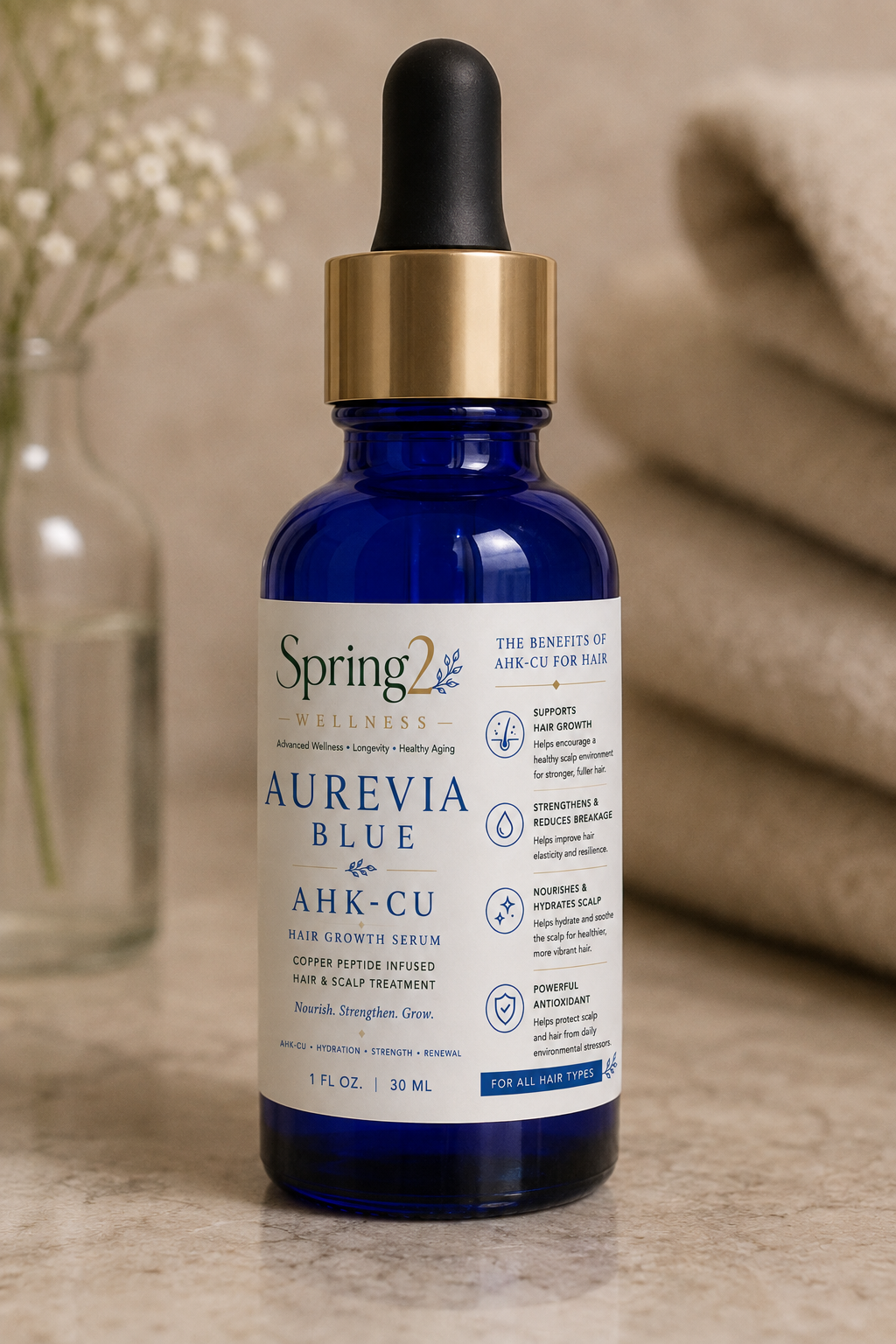
Hair-growth products are full of ingredients promising thicker, stronger, faster-growing hair. Copper peptides have earned a particularly interesting place in that conversation—and AHK-Cu is one of the lesser-known compounds behind it.
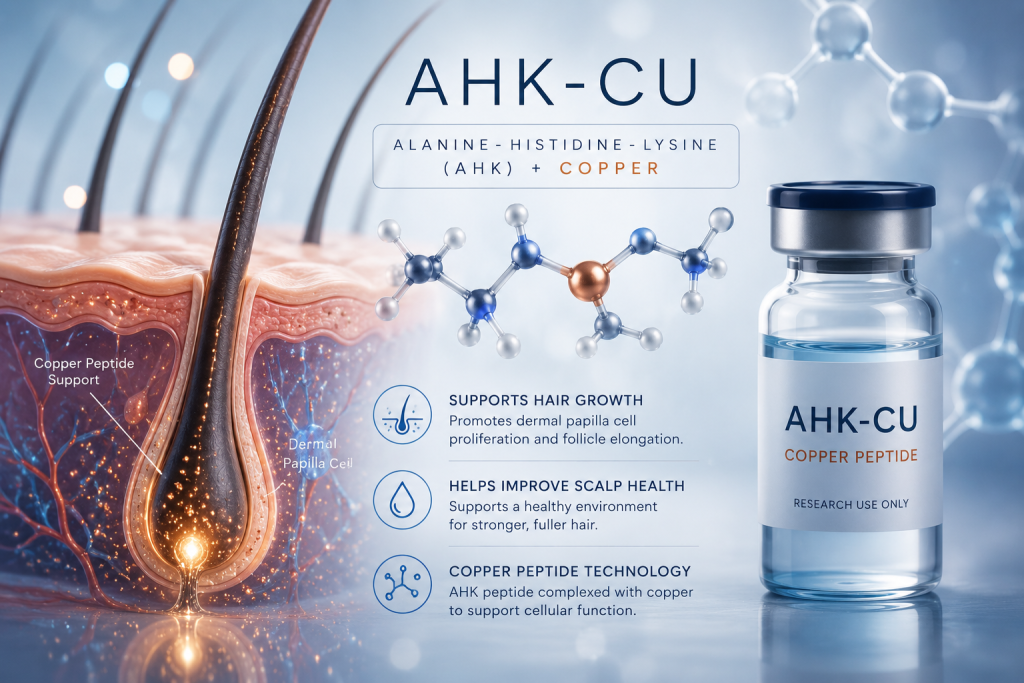
AHK-Cu is a copper-binding peptide formed when the tripeptide AHK (alanine-histidine-lysine) complexes with copper.
If that sounds familiar, there’s a reason.
Its better-known relative, GHK-Cu, is another naturally occurring copper-binding tripeptide that has been studied extensively for its involvement in wound healing, extracellular-matrix remodeling and skin biology.
AHK-Cu, however, has attracted specific research interest for something else:
the human hair follicle.
And unlike many ingredients marketed for hair growth purely on theoretical mechanisms, AHK-Cu has actually been investigated using human hair-follicle cells.
The evidence is intriguing—but considerably more limited than the marketing surrounding copper peptides sometimes suggests.
What Exactly Is AHK-Cu?
AHK is a short peptide consisting of three amino acids:
Alanine – Histidine – Lysine
The histidine within the peptide allows it to form a complex with copper ions, producing AHK-Cu.
Copper isn’t simply there to give the compound its distinctive blue appearance.
Copper is an essential trace element involved in numerous enzymes and biological processes, including connective-tissue formation, antioxidant defense, cellular metabolism and tissue remodeling.
Peptides such as AHK and GHK can act as copper-binding molecules, influencing how copper participates in biological environments.
That relationship between peptide signaling and copper biology is what makes copper peptides particularly interesting research compounds.
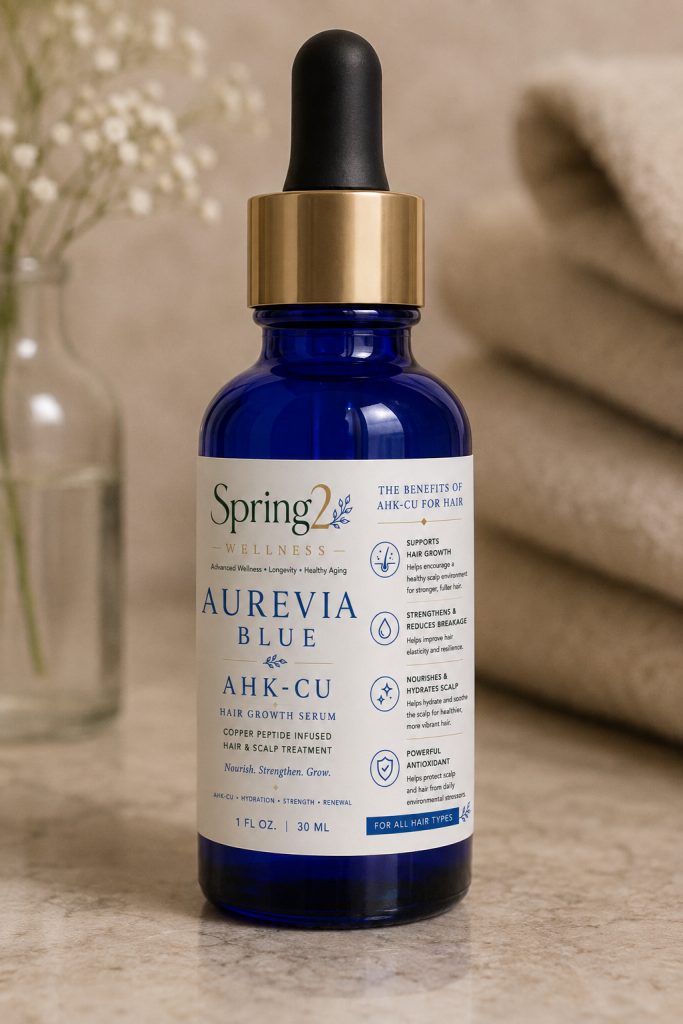
Why Researchers Became Interested in AHK-Cu for Hair
Hair follicles aren’t passive structures.
They’re miniature organs containing multiple populations of specialized cells that continuously communicate with one another.
One particularly important population is the dermal papilla cells located near the base of the follicle.
These cells help regulate hair-follicle development and cycling and participate in signaling that influences whether a follicle grows, transitions or rests.
Because dermal papilla biology is so important to hair growth, researchers frequently use these cells when investigating potential hair-growth compounds.
And that’s where AHK-Cu becomes interesting.
A published laboratory study investigated the effects of AHK-Cu on human dermal papilla cells and isolated human hair follicles.
Researchers reported that AHK-Cu promoted elongation of human hair follicles maintained in culture and stimulated proliferation of dermal papilla cells.
That’s substantially more informative than simply saying that copper is “good for hair.”
Researchers were observing effects directly within biological systems involved in human hair growth.
AHK-Cu and Human Hair Follicles
In the study, researchers cultured isolated human hair follicles and exposed them to AHK-Cu.
They reported increased follicular elongation compared with controls.
That matters because hair-shaft elongation provides an experimental way of examining whether a compound influences the growth activity of an intact follicle.
Researchers also examined dermal papilla cells separately.
AHK-Cu increased proliferation of these cells under the experimental conditions.
Taken together, those findings provide a legitimate biological basis for continued investigation of AHK-Cu in hair research.
But there’s an important limitation:
A follicle growing in laboratory culture is not the same thing as someone’s hair becoming visibly thicker after applying AHK-Cu to their scalp.
That’s the distinction we have to maintain throughout this research.
AHK-Cu vs. GHK-Cu
Because their names are so similar, these two compounds are frequently treated as interchangeable.
They’re related, but they’re different peptide sequences.
AHK: Alanine-Histidine-Lysine
GHK: Glycine-Histidine-Lysine
Both can bind copper.
GHK-Cu has a much broader research history and is particularly well known for its involvement in skin remodeling, wound healing, collagen biology and tissue repair.
AHK-Cu has a much smaller literature.
However, its direct investigation in human hair follicles and dermal papilla cells makes it especially interesting from a hair-research perspective.
This doesn’t mean:
AHK-Cu = hair peptide
GHK-Cu = skin peptide
Biology isn’t that tidy.
It simply means the available research emphasis differs between the two compounds.
Could AHK-Cu Help Create a Healthier Follicle Environment?
Potentially—and this is probably the most scientifically reasonable way to think about the compound.
Hair growth depends on far more than simply making hair “grow faster.”
A follicle’s behavior is influenced by cellular signaling, hormones, inflammation, vascular support, extracellular matrix, nutritional status and the normal hair-growth cycle.
AHK-Cu’s observed effects on dermal papilla cells and VEGF suggest that it may influence some components of this environment.
Copper-peptide biology more broadly also intersects with processes involving extracellular-matrix remodeling and tissue repair.
That’s why AHK-Cu makes an interesting scalp and follicle research compound rather than merely another cosmetic conditioning ingredient.
But we still need clinical research to determine whether those cellular effects translate into meaningful improvements in human hair density.
What About Hair Thickness?
This is another claim worth separating from what researchers actually measured.
If a compound improves follicular activity, it’s tempting to immediately conclude that it produces thicker hair.
But hair thickness can mean several different things:
the diameter of individual hair shafts,
the number of actively growing follicles,
the percentage of follicles in anagen,
or simply the visual appearance of fuller hair.
Those aren’t interchangeable outcomes.
The existing AHK-Cu research provides a rationale for investigating hair growth, but we don’t currently have the kind of large clinical trials measuring hair counts, shaft diameter and photographic density over many months that exist for established hair-loss treatments.
So “AHK-Cu has been studied in human hair follicles” is fair.
“AHK-Cu has been clinically proven to regrow thinning hair” is not.
Where AHK-Cu Research Gets Especially Interesting
The most compelling thing about AHK-Cu isn’t that researchers discovered a magical hair-growth switch.
It’s that several observations point in the same general direction.
Researchers saw:
human hair-follicle elongation,
dermal papilla-cell proliferation,
and changes in VEGF expression.
Those findings provide multiple biological reasons to continue studying the compound.
That’s exactly what early-stage research is supposed to do.
It identifies a signal worth investigating further.
The next step should be rigorous human clinical trials.
What We Don’t Know Yet
There are still some enormous unanswered questions.
Does topical AHK-Cu penetrate human scalp tissue sufficiently to reproduce laboratory effects?
What concentration would produce meaningful biological activity?
Does it increase the number of hairs entering or remaining in the anagen phase?
Does it affect actual hair density?
Are its effects different in androgenetic alopecia versus other forms of hair thinning?
How does it compare directly with established treatments?
Does combining it with other copper peptides provide any advantage?
And what does long-term exposure do?
These are exactly the questions that would require properly designed human trials.
Until those exist, the evidence should remain in perspective.
AHK-Cu Isn’t Minoxidil
This comparison is important.
Minoxidil has decades of clinical use and controlled human trials demonstrating effects on hair growth.
AHK-Cu does not have anything approaching that evidence base.
That doesn’t make AHK-Cu scientifically meaningless.
It means they’re at very different stages of evidence.
AHK-Cu belongs in the category of:
promising experimental hair-follicle research.
It should not be presented as though it has already cleared the evidentiary hurdles of an established hair-loss treatment.
Why AHK-Cu Is Worth Watching
Among the enormous number of compounds marketed for hair, AHK-Cu at least has an interesting scientific foundation.
It is a genuine copper-binding peptide.
It has been studied directly in human dermal papilla cells.
It has been tested using isolated human hair follicles.
Researchers observed increased follicular elongation and dermal papilla-cell proliferation and identified VEGF signaling as one possible component of its biological activity.
That’s enough to make AHK-Cu worth researching.
It’s not enough to declare the hair-loss problem solved.
And that distinction is exactly where responsible peptide education should live.
The most interesting question isn’t whether AHK-Cu is a miracle hair-growth peptide.
It’s whether the cellular effects researchers have already observed can eventually be reproduced as meaningful hair-growth outcomes in living humans.
That’s the research we still need.
Research & Educational Disclaimer
This article is provided for research and educational purposes only and is not medical advice. It does not provide instructions for preparing, dosing, applying, injecting or otherwise using AHK-Cu. Hair loss can have numerous medical and non-medical causes, and experimental peptide research should not be treated as a substitute for evaluation or treatment by an appropriately licensed healthcare professional.